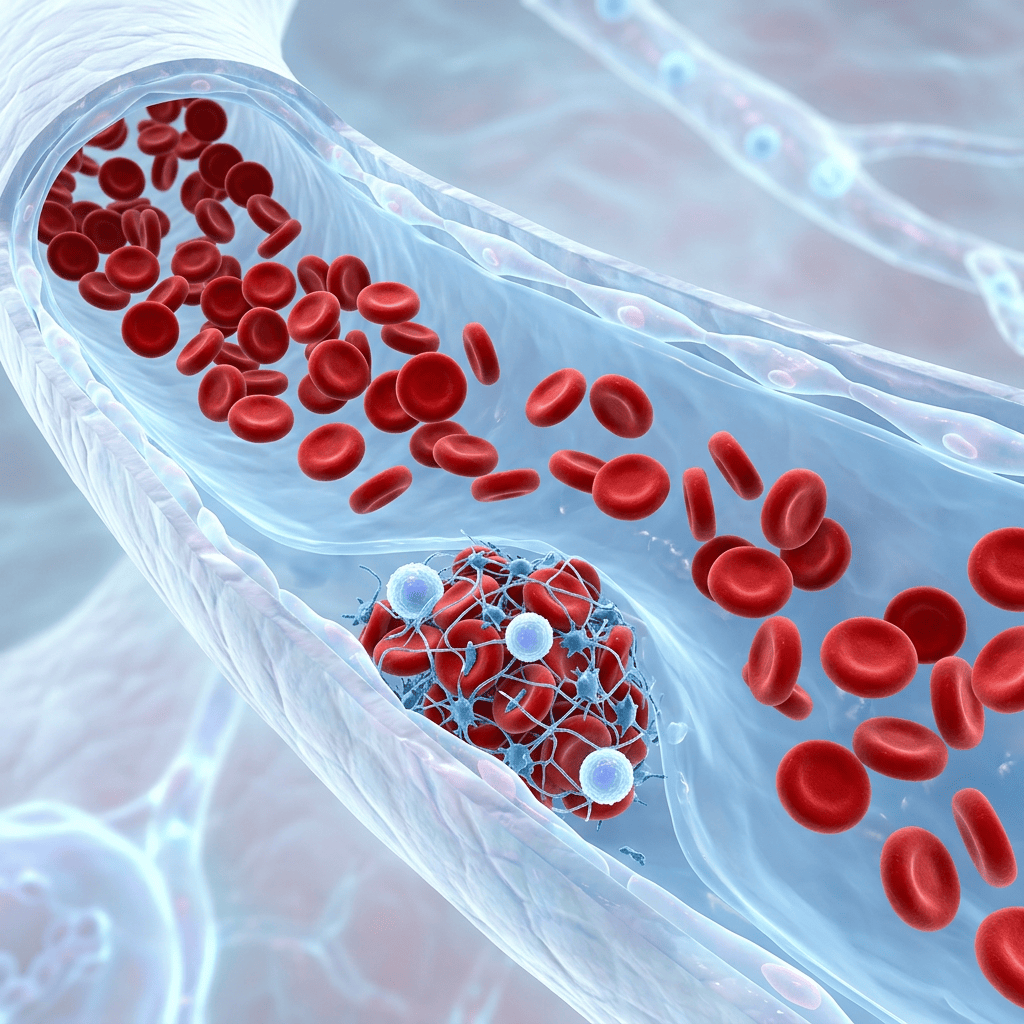
Every year on October 13, World Thrombosis Day gives us a moment to pause and talk about something vital that often stays hidden in plain sight: blood clots. If you are sitting across from me in my clinic today, I want to reassure you that this is not a conversation meant to frighten you. Instead, think of it as an invitation to understand how your body takes care of you, how to spot when it needs a helping hand, and how you can gently take charge of your own wellbeing.
At its core, thrombosis simply means a blood clot has formed inside a blood vessel, slowing down or blocking the natural, nourishing flow of blood. Our blood is naturally designed to clot when we get a scrape or a cut—it is a protective mechanism. But occasionally, a clot forms where it shouldn’t. When it develops in a deep vein, usually nestled deep inside the calf or thigh, we call it Deep Vein Thrombosis (DVT). If a piece of that clot ever breaks loose and travels up toward the lungs, it becomes what we call a Pulmonary Embolism (PE).
The trick with blood clots is that they rarely announce themselves with dramatic fanfare right away. More often, patients sit in my office and describe subtle changes they almost brushed off: one calf feeling strangely heavy or tight, a patch of warmth or redness along the leg, or mild swelling in just one ankle that wasn’t there yesterday. Those are the early cues of a DVT. The true red flags—the moments where you do not wait, but pick up the phone or head straight to urgent care or an emergency room—are sudden shortness of breath, a sharp chest pain when taking a deep breath, an unprompted racing heartbeat, or an unexplained cough. Trusting your instincts in those moments can genuinely save your life, and no doctor will ever fault you for getting checked out.
When a clot is identified, modern medicine has very effective, well-established tools to help. In our medical toolkit, the mainstay is anticoagulant medication—often called blood thinners. These medications do not literally thin your blood like water; rather, they gently interrupt the clotting process, keeping existing clots from growing while giving your body’s natural enzymes the time they need to dissolve them safely. In rarer, more acute scenarios, hospital specialists might use medications called thrombolytics to dissolve large clots rapidly. We also frequently recommend graduated compression stockings to encourage circulation, alongside thoughtful reviews of your hydration, activity levels, and personal medical history.
This year, World Thrombosis Day places a heartfelt spotlight on women, particularly those of us who are 55 and older. Entering this chapter of life is not a diagnosis or a deficit; it simply brings a natural shift in our biological landscape. Post-menopause, our hormonal balances settle into new rhythms, blood vessels change in tone, and recovery from routine surgeries or illnesses can take a little longer. At the same time, life after 55 often brings profound shifts in how our days look. Many women find themselves sitting for longer stretches—perhaps working at a desk, recovering from an orthopedic procedure, traveling, or dedicating countless hours to caregiving for aging parents, partners, or grandchildren.
That caregiving instinct brings us to a quiet truth I see every week in practice. Women spend decades tuning their ears to everyone else’s needs. You know the exact dates of your family’s prescriptions, the rhythms of your household, and how to hold space for others, yet you may have gradually turned the volume down on your own physical sensations.
This is where somatic hypnotherapy offers a gentle, beautiful bridge. Somatic hypnotherapy does not treat, dissolve, or cure a blood clot—that remains the essential job of clinical medicine and timely prescriptions. What somatic work does provide is a pathway back home to your own body. It invites a mindful, embodied awareness that helps you notice tension, recognize when you have been sitting still for hours, and tune back into the natural rhythm of your breath and muscles.
Blood, breath, and spirit are meant to move in continuous, effortless flow. When we practice somatic awareness, we stop treating the body like an instrument that must quietly endure, and begin treating it as a partner we listen to with warmth.
Right now, as you finish reading this, take just sixty quiet seconds. Let your feet rest flat against the floor. Feel the contact beneath your soles. Notice the gentle weight of your calves, the ease in your thighs, and the natural rise and fall of your chest. Without any judgment or urgency to fix anything, simply ask yourself: What would bring a little more ease and flow into my day? Perhaps it is a cool glass of water, a five-minute stroll around the garden, a gentle stretch of your ankles, or finally picking up the phone to discuss a lingering ache with your doctor. Taking control begins with paying attention, honoring your body’s wisdom, and giving yourself the same loving care you so freely offer the world.
References:
1. International Society on Thrombosis and Haemostasis (ISTH). World Thrombosis Day 2026 Campaign Materials: From Head to Toe, Take Control. Available at: worldthrombosisday.org.
2. ISTH. World Thrombosis Day 2026 Campaign Calls for Greater Awareness of Women’s Blood Clot Risks (September 10, 2026).
3. ISTH. Educational Resources and Clinical Guidelines for Venous Thromboembolism.


Leave a Reply