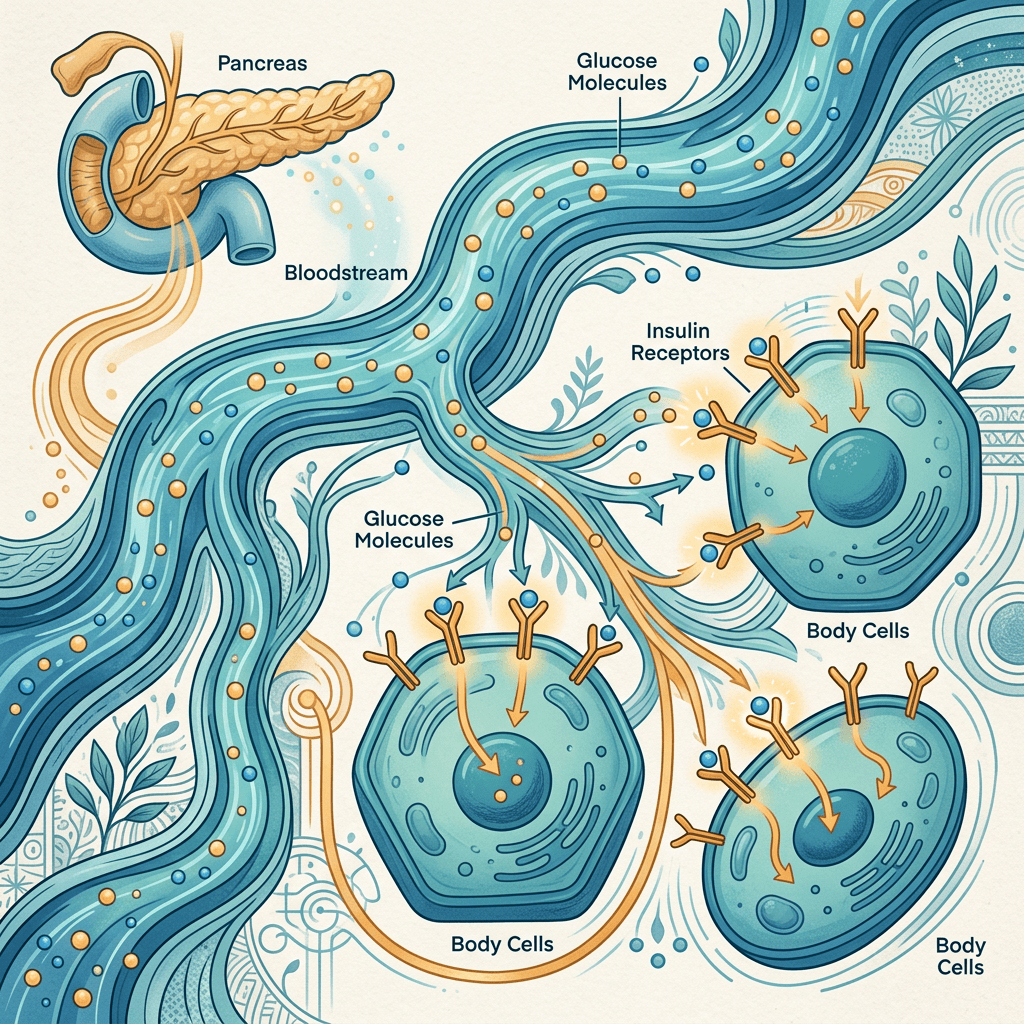
The Multilevel Survival Guide to Diabetes
Mandatory “Don’t Sue Me, Keep Taking Your Meds” Disclaimer: Before we dive into epigenetics, ancestral chats, or Ayurvedic spices, let’s be crystal clear: This article is educational, reflective, and seasoned with a dose of humor. It is not a replacement for your doctor, your lab tech, or your insulin pen.
If you decide to replace Metformin with a full moon meditation, chant your blood sugar into normal range, or tell your endocrinologist that your pancreas is merely “expressing transpersonal fatigue,” stop right there. Ancestral healing, organ dialogues, and herbal teas are wonderful allies for your emotional balance and sanity, but they do not metabolize a bowl of gulab jamun for you. Keep taking your prescribed meds, prick your fingers, monitor that HbA1c, and run any lifestyle tweak past your actual physician. Deal? Deal.
What Exactly Is Diabetes (and Why Is Your Pancreas Pouting)?
At its core, Diabetes Mellitus is your body’s metabolic accounting department throwing up its hands in defeat.
Normally, when you eat, your food turns into glucose (fuel), and your pancreas releases insulin—the metabolic concierge who unlocks your cells so glucose can walk inside and do some work.
In diabetes:
- The Concierge Quits: The pancreas doesn’t make enough insulin.
- The Cells Change the Locks: The cells become resistant to insulin, pretending they aren’t home.
- Or Both: A total breakdown of communication.
Meanwhile, that stranded glucose hangs around in the bloodstream, throwing an unauthorized rave that slowly damages your heart, blood vessels, retinas, kidneys, and peripheral nerves.
The Clinic Confessionals: “I Thought I Was Just Tired…”
Most folks don’t get a formal engraved announcement that their blood sugar is elevated. Instead, they walk into a clinic saying:
- “I thought I was just getting older.”
- “I’m drinking so much water I could sponsor a municipal reservoir.”
- “I wake up four times a night to pee—it’s basically my primary hobby now.”
- “My vision keeps blurring, but maybe it’s just the menopause/work stress/dust.”
In medical textbooks, these are the Three P’s of Metabolic Revolt:
- Polyuria: Urinating constantly (the kidneys trying to flush out excess syrup).
- Polydipsia: Unquenchable thirst (to replace what you just flushed).
- Polyphagia: Relentless hunger (because your starving cells never got the memo that lunch arrived).
Tack on bone-deep fatigue, recurrent infections, cuts that heal in geological time, tingling feet, and brain fog—symptoms that busy people (especially caregivers and women juggling the universe) routinely write off as “just modern life.”
The Ayurvedic Take: When Agni Smolders and Kapha Gets Cozy
Long before automated lab analyzers, Ayurveda already had a descriptive file on this condition, classifying it under Prameha (disorders of excessive urination), which culminates in Madhumeha—literally “sweet urine.”
According to Ayurvedic thought:
- The Fire Problem (Manda Agni): Your digestive fire (Agni) isn’t burning clean; it’s smoldering like wet firewood. Weak digestion creates Ama (toxic, half-cooked metabolic sludge) that clogs your micro-channels (Srotas).
- The Dosha Imbalance: It’s heavily tied to aggravated Kapha (sluggishness, heaviness, water retention) choking Vata, which then drags bodily essences (Ojas) straight out through the urinary tract.
- Ayurvedic Remedies as Support: Herbs like Karela (Bitter Gourd—nature’s not-so-subtle reality check), Methi (Fenugreek seeds soaked overnight), Gudmar (literally “sugar destroyer,” which temporarily numbs your tongue to the taste of sweets), and Triphala are used to wake up sluggish digestion and scrape away Ama.
Rule of thumb: Ayurveda is fantastic for priming the gut and rebooting daily rhythms (Dinacharya), but it is a dance partner to your modern medical care, not an eviction notice for your prescriptions.
Epigenetics: Your DNA Is a Script, Not a Life Sentence
In casual wellness chatter, people love to say: “My family’s generational trauma gave me this condition.”
Well, yes and no. Think of your DNA as a massive theatrical script. You can’t rewrite the printed letters, but epigenetics determines which scenes the director actually stages and which lines get cut:
- DNA Methylation: Microscopic chemical tags act like sticky bookmarks saying, “Read this page,” or “Skip this entire chapter.”
- Histone Modification: Your DNA wraps tightly around proteins like thread on spools. Tightly spooled? Skipped. Loosely spooled? Actively performed.
- Non-Coding RNAs: The backstage crew fine-tuning what actually makes it into production.
Chronic stress, sedentary living, processed foods, and systemic inflammation act as overbearing stage directors that flag the metabolic-dysfunction pages. The good news? Healthy routines, movement, and stress management can convince your cells to bookmark the healthier chapters instead.
The Ancestral Burden: The “Service Until Breakdown” Script
Sometimes the most revealing question isn’t “What happened to my genes?” but “What did my lineage have to endure?”
Did your grandparents survive famines where hoarding every calorie meant the difference between life and death? Did the matriarchs in your family treat resting like a cardinal sin, running on fumes until their bodies forcibly grounded them at age forty-five?
Consider a case from guided imagery and transpersonal work: A woman engaged in a symbolic dialogue with her pancreas. When asked what it needed, the organ replied:
“I only planned to work until forty. That’s when the women in our family decline.”
Scientifically, your pancreas does not sit around reading family diaries or harboring subconscious beliefs about your 40th birthday. But psychologically and symbolically, that imagery exposed a toxic inherited script: Women serve until they burn out, and decline is mandatory.
Releasing that internal narrative doesn’t replace insulin, but it gives you permission to finally prioritize your own body without drowning in guilt.
The 5-Pillar Integrative Playbook
Managing diabetes requires a layered strategy across every level of your life:
| Pillar | Focus | Practical Action |
| 1. Modern Medicine (Non-Negotiable) | Clinical Baseline | Regular HbA1c tests, doctor checkups, eye & kidney screenings, daily foot checks, and diligent medication adherence. |
| 2. Lifestyle & Ayurveda | Fuel & Rhythm | Balanced carbs, high fiber, daily brisk walks, strength training (muscle is your best glucose sink), and Ayurvedic bitter herbs (Karela, Methi) to kindle Agni. |
| 3. Nervous System | Cortisol Takedown | Chronic stress floods your system with cortisol, driving glucose through the roof. Counter it with breathwork, somatic unwinding, and proper restorative sleep. |
| 4. Ancestral Audit | Rewriting the Rules | Interrogate family beliefs: Did they preach that rest is lazy? That food must never be left on a plate? Keep what honors survival, discard what harms health. |
| 5. Transpersonal Care | Meaning & Self-Care | Guided imagery, meditation, journaling, and listening when your exhausted body asks for basic rest, boundaries, and a little genuine sweetness in life. |
The Campfire Reflection
Picture your mother, your grandmother, and your younger self sitting around a quiet campfire.
Ask them: “What beliefs did you have to cling to just to survive?”
One might answer: “Work until your hands bleed.”
Another might say: “Never let anyone see you rest.”
A third might whisper: “Feed everyone else first, eat whatever crumbs are left.”
Bow your head, thank them for their grit—because without their endurance, you wouldn’t be sitting here today—and then gently tell them:
“Thank you. You did what you had to do to survive. But I am stepping out of the loop. I choose rest, balanced nourishment, clear boundaries, and a body that is allowed to thrive.”
That shift won’t instantly reset your morning fasting numbers, but it will transform the way you inhabit your body while you do the work to heal it.
This post is part of Blogchatter Collective writing.


Leave a Reply