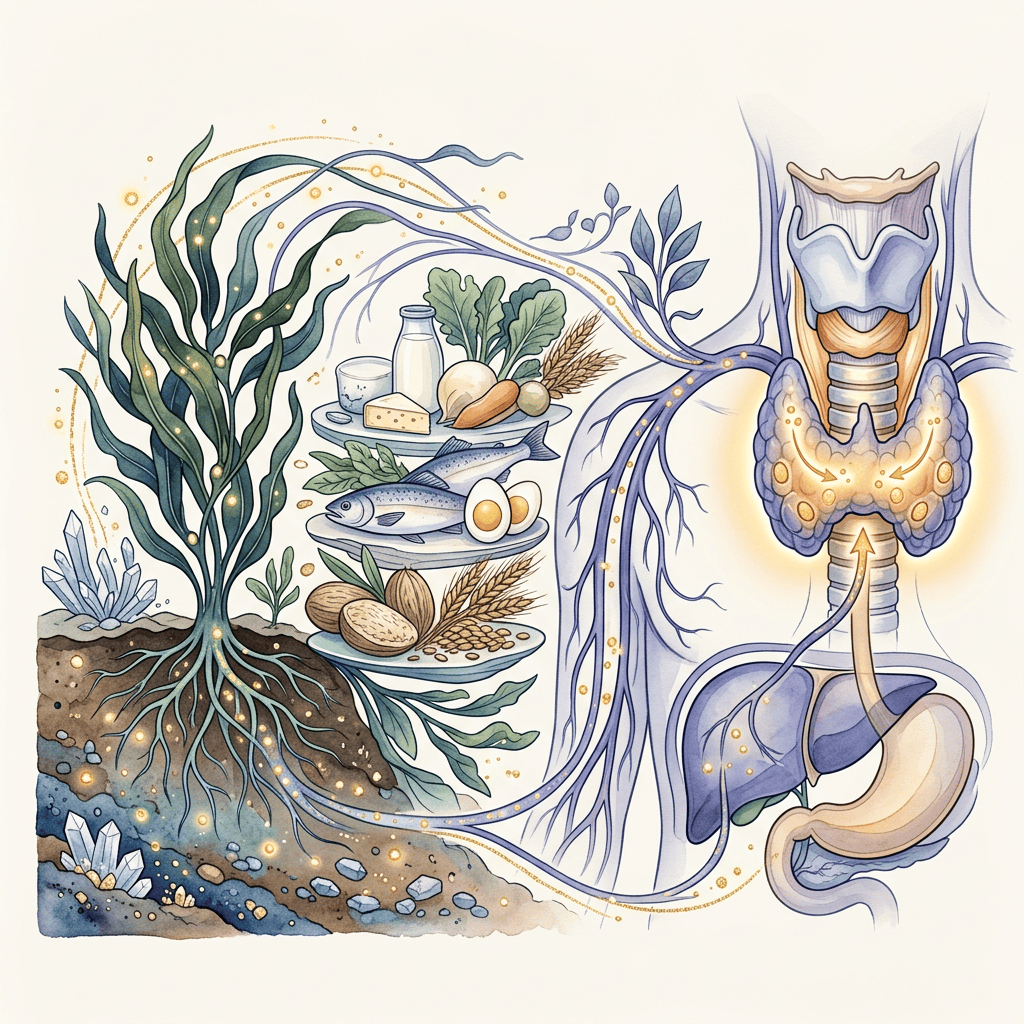
If you walked into a kitchen and tried to impress someone with your nutritional prowess, you would probably talk about vitamin C, omega-3s, or cutting carbs. Nobody writes poetry about iodine. It sits quietly on the kitchen counter in a humble cardboard cylinder or a plain plastic packet, mixed in with the table salt, doing its job without a PR agency.
Yet, October 21 marks Global Iodine Deficiency Disorders Prevention Day. Every year on this date, public health professionals remind the world that a microscopic speck of a mineral is often all that stands between healthy brain development and preventable cognitive decline.
The Tiny Boss in Your Neck
Your body contains a small, butterfly-shaped gland resting at the base of your throat: the thyroid. Think of the thyroid as the master furnace and conductor of your metabolism. It produces two main hormones: thyroxine (T4) and triiodothyronine (T3).
These hormones dictate how fast your cells burn fuel, how your heart beats, how warm you feel on a brisk morning, and how crisply your neurons communicate.
Here is the catch: your thyroid cannot synthesize these hormones without iodine, and your body cannot produce iodine internally. It has to come from what you eat.
When iodine is scarce, the thyroid attempts to compensate. It swells, stretching into a visible bulge called a goiter—essentially the gland working overtime, waving its arms to capture whatever stray atoms of iodine pass by in the bloodstream. If the shortage persists, the furnace slows down. Hypothyroidism sets in, bringing along sluggishness, unexplained weight gain, brittle hair, persistent chilliness, and a mental fog that makes finding your keys feel like an archaeological expedition.
The Soil Problem: Why We Iodize Salt
A frequent dinner-party assumption goes like this: “If I eat an organic, whole-food diet, I will get every nutrient naturally.”
With iodine, geography has other ideas.
Over millions of years, glacial movement, flooding, and heavy rains washed iodine out of topsoil and carried it into the oceans. If vegetables grow in iodine-depleted soil—which describes massive swathes of the Indian subcontinent, river valleys, and mountain ranges—those vegetables contain little to no iodine. Seaweed and ocean catch have plenty, while dairy, eggs, and inland produce vary unpredictably based on animal feed and regional soil quality.
That environmental quirk placed entire regions at risk. Historically, over 337 districts in India alone were recognized as endemic zones for iodine deficiency disorders. Globally, an estimated 1.5 to 1.9 billion people still live at risk of inadequate iodine intake.
Rather than expecting every household to forage for kelp or decipher regional soil charts, public health agencies introduced a simple solution: universal salt iodization. Since virtually everyone eats salt, fortifying it with tiny, measured amounts of iodine ensures daily physiological needs are met for pennies a year.
In India, the National Iodine Deficiency Disorders Control Programme (NIDDCP) turned this into an impactful reality:
- According to the National Family Health Survey (NFHS-5), 94.3% of Indian households consume adequately iodized salt.
- Recent government quality audits show over 92% to 93% of sampled salt consistently meets national benchmarks (>15 ppm).
Because the soil remains naturally low in iodine, keeping salt iodized is an ongoing necessity rather than a problem that stays solved on its own.
How Much Do You Actually Need?
You need only a pinch of iodine across an entire year—roughly a single teaspoon spread over a lifetime. But the thyroid demands it in steady, daily micro-doses:
| Life Stage | Recommended Daily Intake |
| School-age Children | 90 – 120 mcg |
| Adults | 150 mcg |
| Pregnant Women | 220 – 250 mcg |
| Lactating Women | 250 – 290 mcg |
Note: 150 micrograms (mcg) is about 0.00015 grams—an amount invisible to the naked eye.
From the Womb to the Classroom
The most critical window for iodine occurs during the first 1,000 days of life, beginning at conception.
A developing fetus relies entirely on maternal thyroid hormones during early gestation to build its neural architecture: guiding neurons along their migration routes, weaving synapses, and insulating nerve pathways with myelin. Severe deficiency during pregnancy carries devastating consequences, from miscarriage and congenital complications to profound intellectual disability.
Even mild-to-moderate deficiencies during childhood quietly subtract IQ points, reduce working memory, and impair school performance. That makes adequate iodine one of the most effective, low-cost investments in global human capital.
The Aging Thyroid: A Narrower Runway
While public health often emphasizes childhood brain development, iodine remains just as relevant in older adulthood.
As people age, thyroid reserve naturally dips, peripheral conversion of T4 to T3 becomes less efficient, and kidneys clear iodine more slowly. This narrows the “sweet spot” for safe intake.
In seniors, subtle thyroid dysfunction often masquerades as normal aging:
- “Brain fog” and slowed recall get blamed on senior moments instead of an underactive thyroid.
- Muscle fatigue, slower gait, and sarcopenia get brushed off as frailty.
- Persistent cold intolerance gets met with a thicker cardigan rather than a simple thyroid panel.
- Cardiovascular rhythm issues like bradycardia (slow heart rate) or atrial fibrillation (rapid fluttering) can be triggered by iodine deficiencies or sudden excesses.
Older adults also frequently navigate polypharmacy. Medications like amiodarone (a heart medication loaded with iodine), lithium, and even iodinated contrast dyes used in CT scans can disrupt thyroid balance.
The Goldilocks Rule: More Is Not Better
Because iodine is essential, well-meaning health enthusiasts occasionally fall into the trap of over-supplementation. Taking mega-dose kelp drops or unregulated herbal thyroid extracts can backfire.
Flooding an older or vulnerable thyroid with excess iodine can trigger thyroiditis, sudden hyperthyroidism, or paradoxical shutdowns in hormone production (the Wolff-Chaikoff effect). The goal is steady adequacy, not excess. A standard, balanced diet seasoned with regularly iodized table salt remains the safest baseline.
Iodine operates quietly, but its influence touches brain architecture in infancy, metabolic rhythm in adulthood, and functional independence in old age. A well-stocked salt shaker remains one of medicine’s most reliable public health tools.
References
- World Health Organization (WHO). Iodine Deficiency, Nutrition Landscape Information System. [who.int]
- Directorate General of Health Services, Ministry of Health and Family Welfare, Government of India. National Iodine Deficiency Disorders Control Programme (NIDDCP). [dghs.mohfw.gov.in], [nhm.gov.in]
- Iodine Global Network (IGN) & UNICEF South Asia. Status of the Iodine Nutrition and Salt Iodization Program in India (2023). [ign.org]
- Yadav, K., & Pandav, C. S. National Iodine Deficiency Disorders Control Programme: Current Status & Future Strategy. Indian Journal of Medical Research. [ijmr.org.in]
- WHO Europe & Iodine Global Network. People in the WHO European Region at Greater Risk of Iodine Deficiency Due to Changing Diets. [who.int]
- India Today Health. World Iodine Deficiency Day: Causes, Symptoms and Prevention of Iodine Deficiency.
- Khudair, A., et al. Beyond Thyroid Dysfunction: The Systemic Impact of Iodine Excess. Frontiers in Endocrinology. [frontiersin.org]
- Zugravu, C.-A., Petre, M., & Constantin, C. Iodine and Thyroid Dysfunction in Ageing: Nutritional, Pharmacologic, and Microbial Modifiers in Older Adults. Geriatrics. [pmc.ncbi.nlm.nih.gov], [mdpi.com]
- Springer Nature. Iodine Excess Is Associated with Thyroid Dysfunction Among the Elderly. [link.springer.com]
- Food Science & Nutrition. Iodine Consumption and Cognitive Performance. [pmc.ncbi.nlm.nih.gov]
- Zimmermann, M. B., & Boelaert, K. Iodine Deficiency and Thyroid Disorders. The Lancet Diabetes & Endocrinology. [thelancet.com]
- Nutrients. Iodine in Health and Disease: A Comprehensive Review. [mdpi.com]


Leave a Reply