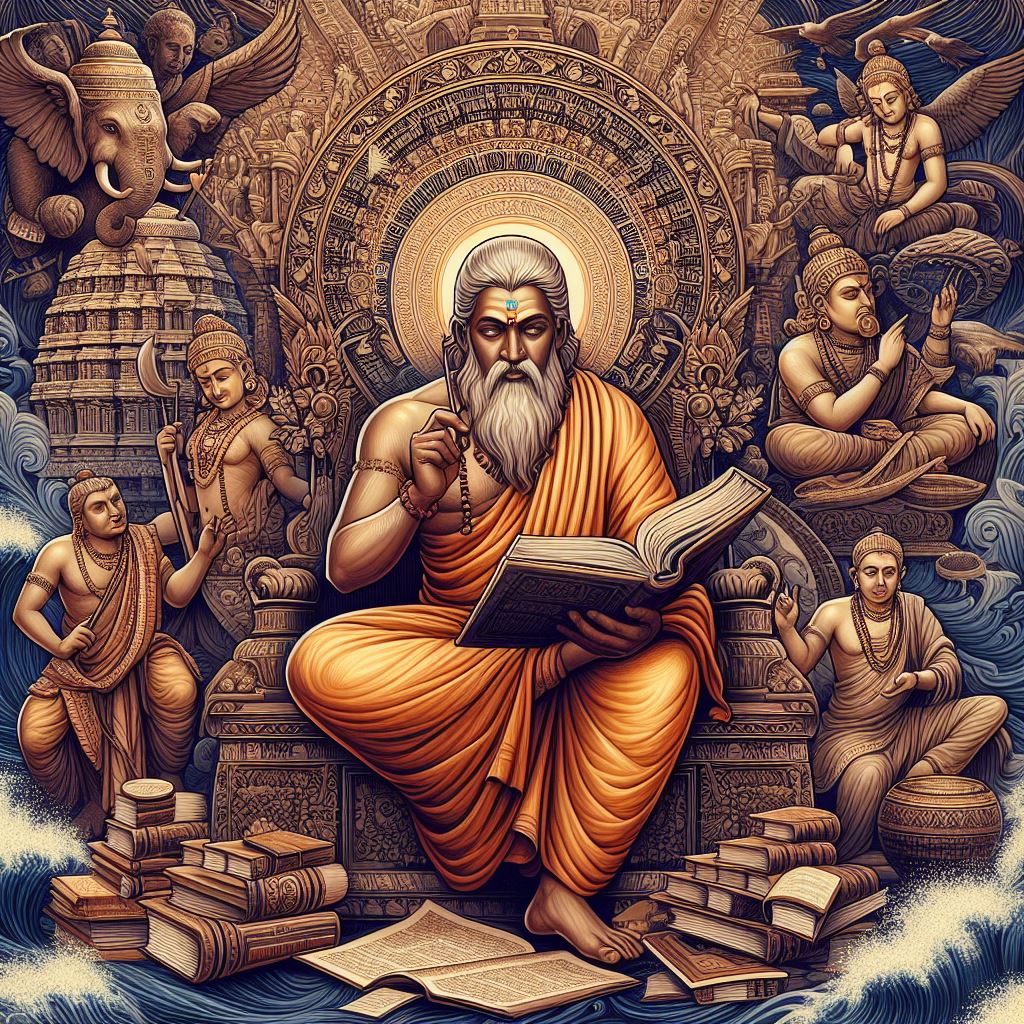
Growing up in a household where dinner table conversation was either books, or politics I was introduced to Thirukural at a very young age. Though formally It was uncle Dr.H.V. Hande who gifted me the Thirukurral in English a Bhavan’s publication version of this timeless work.
when I re-read Thirukurral as an adult some things struck a cord and this was the basis for my paper presented in the SSEAR (conference of society of south east Asian religious studies) on the spirituality, philosophy and health. The tenets of Thirukural did not delve too much into morality the emphasis was patient care, care of the care-giver prevention of burnout. it nuanced approach fosters healthy relationship making more than just a cultural artifact.
the Thirukurral has these tenets
- the body thrives when the five elements within, in proper measure maintain the healthful harmony of life.
- about self-care and preventing burnout particularly when it comes to caregiving of elders the Kural says in the care of others, guard thyself, without self-care even the noblest of heart may flatter.
- a tranquil mind, a healthy body are the foundation of enduring and well-being
- true health encompasses mind, body and soul a trinity of balance that nurtures a life well-lived.
- Eating in moderation, for excess invites ailments, a mindful diet ensures the body’s enduring vitality
- The power of rest is also acknowledged ~ in the stillness of rest, the body rejuvenates a well-rested soul finds strength anew.
- Harmony with nature ~ align thy life with nature’s rhythms for therein lies the secret to enduring health.
- In movement the body finds its strength, let exercise be the silent architect of thy wellbeing – is about the importance of physical activity.
- As a tree bends but does not break in the storm a resilient mind withstands the trails of life.
- A sound min, a robust body – each sustains the other in the symphony of life. This I think resonated the most with me the journey of looking into our philosopher’s I mean the southern Dravidian thinkers.
one notable chapter delves into balancing the Pancha Bhutas the five elements of the body, this is then corelated with the life-style and living, to maintain optimal health. The ideology aligns with Jaimini Sutra emphasizing the importance of elemental equilibrium. There are references to Epigenetics too.
Despite the profound wisdom encapsulated in the Thirukurral and the impact of the saint on everyday life, Thiruvalluvar’s life remains shrouded in mystery. The lack of authentic information has led to speculations about his background. These are quite conflicting. Some associate him with Jainism citing his knowledge of Sanskrit legal texts, while others claim he came from an agricultural background.
Determining Thiruvalluvar’s birthplace and exact date of his life adds another layer of uncertainty. Theories of his birthplace range from Madurai to Mayilapuram (Myla pore) adding the conflicting information about birth on an iluppai tree or Madurai. The dating of Thiru Kural is equally contentious the estimates are from 300BCE to 6th century CE. However scholarly consensus currently places it around 500CE
The Religious affiliation of Thiruvalluvar is another debate. Scholars argue whether he was a Jain, Hindu or potentially influenced by Buddhism. some see parallels between his teachings and
moral codes, like vegetarianism, and ahimsa. Others interpret his writing as reflection of Hindu concepts such as the four goals of human life, the dharma-Artha- Kama-moksha) the framework of Purushas Artha’s.
The Jain influence of Thiru Kural finds evidence as it includes his use of epithets like ‘Malarmicaiyekinan’ and ‘Ventutual Ventamai ilan”. These according to scholars like Karil Zvelebil align with Jaina-like characteristics. However, there is an absence of Thiruvalluvar’s mentions in early Jain text books questions this narrative.
As there is mention of Gods like Vishnu, or Goddess like Lakshmi in certain couplets, along with concepts found in Hindu texts of course the reference to the four purusharthas, has some scholars suggest a Hindu influence. Interestingly the layout of the Kural also mirrors the four Purushartha’s of Hinduism.
Other than these the non-denominational nature of the Thirukurral has various religious groups including Christians to claim Valluvar and his works. However, there is lack of academic support to hold these debates. However, scholars refute this claim highlighting the absence of congruence between Valluvar’s ideas and Christian morality.
There are claims Valluvar’s connection to Buddhism. There are assertations that he was called ‘Tiruvalla Nayanar’ and that he adhered to Buddhist scriptures. These claims were notably made by the Dalit activist Jyothee Thass. The attempt to re-interpret Valluvar’s work in a Buddhist framework is on.
At the end of the Thiruvalluvar’s Thirukurral transcends religious boundaries, offering timeless wisdom applicable to diverse aspects of life. While the enigma of Thiruvalluvar’s life persists, his teaching continues to inspire and guide generations like it does to me, in the realm of health, patient care and self-care. Thiru Kural’s pragmatic approach and universal insights provide a valuable resource for fostering well-being and harmonious relationships.


 Parwatisingari's Weblog
Leave a reply to parwatisingari Cancel reply