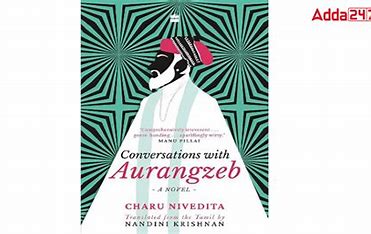
Book Review.
Author: Charu Nivedita
Translator from Tamil Nandita Krishnan.
ISBN: 9789 356 993 921
publisher: HarperCollins India.
It was the title that got my fancy conversations with Aurangzeb the emperor who gave us Aurangabad, the favourite target of all Hindutva, the simple man whose personal life was about selling caps and surviving on that income.
However, when I began reading it, it was an absolute disappointment the first 5 chapters were dedicated to the flirting of the author and his translator … it was terribly unfunny.
However, once the emperor made his presence through an Aghori as the author was researching Mirra who eventually became a saint… well that quest was hijacked by the emperor.
There are some interesting excerpts from the novel though and insights. Aurangzeb pleads his case saying he was vilified because everyone needs a hero and more importantly everyone needs a villain.
The emperor refers to the famous painting of the elephant charging at him… the point the emperor makes is that the expression on Dara is evident that he is a coward.
Through the book the Emperor laments his lack of marketing skills, and how Ashoka masked his ruthlessness, and other things with good marketing. For every 4 trees that he planted he had a edifice that glorified him. At point the spirit of Aurangzeb enquires “If Ashoka truly repented why did he not release the prisoners after Kalinga? The author through the spirit of Aurangzeb claims that the image of Ashoka that India inherited is very different from the actual man. I have shared the reading list at the end of the post.
Apparently the of Delhi by Nadir Shah was worse than that of Jallianwala Bagh.
in one chapter he claims that Taimur won because he was a Mongolian wolf driven by hunger and not a Chinese horse driven by rules and regulations.
coming to the Mughal empire, SOA (spirit of Aurangzeb…what the heck… let us call it the author) was the vision of Babur, Babur no doubt created the empire but his tragedy was he could not retain what he inherited.
The author through the spirit does talk about a fascination for Babur. The argument being Babur wrote his own biography unlike the later emperors.
Just as the SOA has reverence for Babur, he has disdain for Akbar. The SOA claims that Akbar was an womanizer and Meena Bazar was about women trading.
The author I not the SOA shares with SOA about monogamy. Well, he is kind of been the victim of narrations of the wise men…Monogamy is Brahmanical. The author seems of forgotten that the British took their Hinduism from the brahmins of Nagpur and Hooghly kinds.
Somewhere in the narrative the Ghost of Durgavati turns up; to voice her angst against Akbar, she shares the truth of Jauhar and Saka. However again the author displays his alignment with the Nagpur sages by implying that to Rani Durgavati the country was the current geographic expanse. But to her the country was Gondwana and nothing else. About Akbar’s religious tolerance he says is on par with the politicians of today and their photos hoped Iftar parties.
Out of the blue there enters an character who probably is from another book by the same author. Then there is a journey to south America with a desperate attempt to be scandalous.
Some interesting observation in the book
- Those days men died at war, and women at childbirth.
- There is a difference between a plunderer and a conqueror. The Qalandar is neither, he is wanderer.
- A pure soul descends to the earth and leaves burdened with sins.
- Corruption is not just collecting wealth it is also portrayal of truth as falsehood and lies as fact.
- people migrate out a country because it can no longer support them.
- you and I are one is not possible; you and I are different but we can live in Harmony is the truth.
The SOA claims that he of course levied Zaziya tax for non-Muslims but he also had the Zakat tax for Muslims which of was 2 ½ % of the surplus wealth.
There is acknowledgement of the European traders, the SOA claims that he learnt about the state of people and country from Niccalao Manucci than the spy system.
Again, through the book the author conveys to SOA that Bharatiyar was touted because Rajaji did not like Bharatiyar. Possible after Rajaji belonged more to the Nagpur and other side of Vindhya.
there were various other spirits, like Jahanara, Something or the other Saxena, Murad the brother of the Sultan. Zeb-un-Nissa his daughter there were just one too many spirits popping up.
Recommended reading by the spirit of Aurangzeb:
- Ashokavadana
- Baburnamma reads like a confession and a thriller at the same time.
- Mahavamsa
- Deepavamsa
At the end of the read, there was really nothing very interesting.


Leave a Reply