Undercover Disruptions Of War
I grew up watching two doctors who practiced medicine very differently but observed people in remarkably similar ways—my father, Dr. Srinivasa Rao, and my grandfather, Dr. H. V. Hande. Between them, across clinics, waiting rooms, and dinner table conversations, I was exposed less to diseases and more to behavior—how people respond when life becomes uncertain, expensive, or quietly unstable.
They rarely used terms like behavioral economics or crisis psychology, but they described what I now understand as anxiety economics. Patients didn’t just come in with symptoms; they came in with hesitation. A cough that should have been checked earlier was delayed. A routine test postponed. Medicines stretched. Diets simplified not out of discipline, but compulsion. “Let’s wait,” they would say. “We’ll see next month.” That “next month” often carried more weight than the diagnosis.
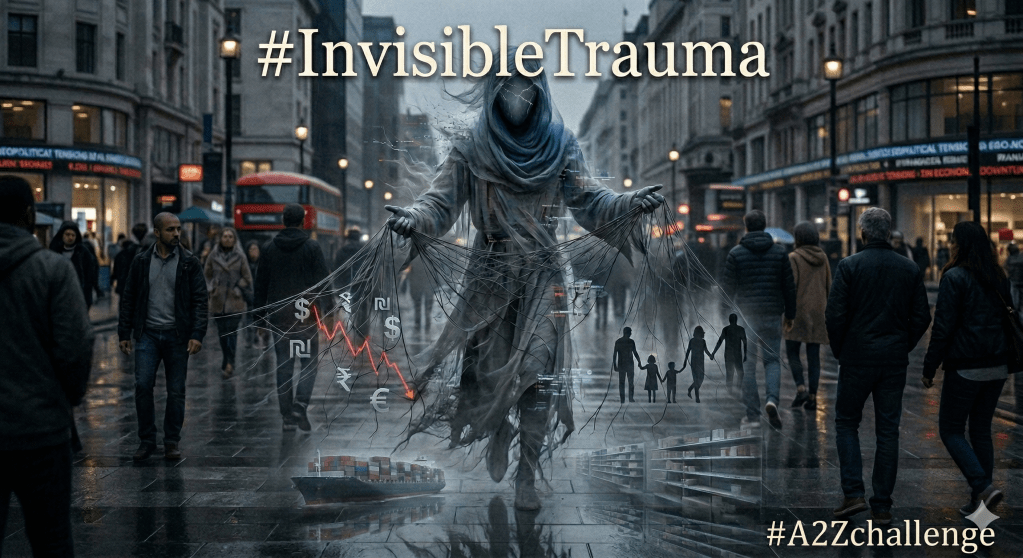
What struck both of them, and now strikes me more sharply in the context of today’s geopolitical tensions—say, the ripple effects of something like an Iran conflict—is that people don’t need bombs falling nearby to start behaving as if something fundamental is breaking. All it takes is the feeling that supply chains might tighten, fuel might rise, or money might not stretch as far. The economy enters the bloodstream as perception, and perception quietly rewires behavior.
I remember my grandfather talking about patients who had lived through the Depression and the war years. He didn’t romanticize their resilience. He noticed their restraint. They saved everything—old containers, bits of cloth, leftover medicine strips. They distrusted waste with almost moral intensity. Even when they could afford better care, they hesitated. Preventive health was seen as indulgence. Spending on oneself carried a faint undertone of guilt.
My father saw echoes of this decades later. Different generation, different triggers—but similar patterns. During periods of inflation or uncertainty, patients began to ration their own lives. Fewer follow-ups. Half-doses stretched into full courses. Diets quietly downgraded. Social visits reduced. Holidays postponed indefinitely. Not because they were told to, but because something inside said: conserve.
This is the scarcity mindset in motion—not dramatic, not visible in headlines, but deeply influential. It narrows attention. It prioritizes the immediate over the long-term. It replaces planning with caution, and caution with quiet anxiety. People begin to operate in a kind of mental tunnel where the question is no longer “what is optimal?” but “what is enough to get by?”
In such a state, even rational decisions take on a different tone. Stockpiling feels prudent. Cutting back feels responsible. Avoiding “unnecessary” expenses—including health check-ups or small joys—feels wise. But the accumulation of these micro-decisions creates a larger pattern. Health issues go untreated. Stress accumulates. Relationships strain under financial caution. Life becomes functional, but thinner.
What my father often pointed out—sometimes with frustration—was how this behavior feeds on itself. When enough people begin to act defensively, the system reflects it back. Shelves empty faster. Prices inch upward. Trust erodes. The fear that triggered the behavior begins to look justified. This is anxiety economics completing its loop: perception shaping behavior, behavior shaping reality.
Now place this in the shadow of a potential Iran conflict. Even without direct involvement, the signals are familiar—oil price speculation, news cycles amplifying uncertainty, supply chain whispers. You don’t need policy changes for households to start adjusting. The adjustment begins in the mind. People start thinking: fuel may rise, costs may increase, better to hold back. And just like that, consumption patterns shift, not by mandate but by mood.
The deeper layer—the one my grandfather hinted at and my father observed repeatedly—is that these behaviors don’t simply disappear when conditions stabilize. They linger. They get taught. Not through lectures, but through habits and tone. A parent who says “don’t waste” with a certain intensity passes on more than advice; they pass on a worldview. Children absorb not the event, but the response to the event.
This is how intergenerational scarcity works. It travels through small acts—saving a plastic bag, delaying a purchase, questioning a medical expense. It embeds itself in how families talk about money, risk, and even pleasure. Over time, it shapes adults who may live in relative stability but carry an inherited caution, a subtle expectation that abundance is temporary.
And yet, it is not entirely negative. The same mindset produces resilience, resourcefulness, and an ability to adapt quickly. My grandfather admired that. My father relied on it in his patients. But both also saw the shadow—the reluctance to invest in well-being, the hesitation to trust stability, the quiet anxiety that never quite leaves.
Watching them, I have come to see that wars and crises do more than disrupt economies; they train behavior. Not just in those who experience them directly, but in those who hear about them, anticipate them, or live through their economic aftershocks. The real legacy is not only inflation or policy shifts, but a recalibration of how people think about security, risk, and enough.
If something like an Iran conflict escalates, its most immediate impact may not be visible in dramatic ways here. It may appear instead in small, almost invisible adjustments—fewer check-ups, quieter spending, cautious conversations at dining tables. And if sustained long enough, these adjustments may harden into habits, and those habits into inheritance.
That is the quiet power of anxiety economics. It does not announce itself. It seeps in, settles, and stays—long after the headlines have moved on.
Footnote:
This post is written for the A2Z Challenge by Blogchatter. Learn more at: https://www.blogchatter.com


Leave a comment