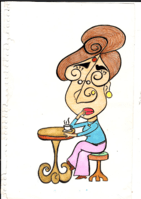
Mother’s Day always produces fascinating clinical material.
As a physician, I see the body keeping score. As a hypnotherapist, I see memory keeping receipts. And as an accidental observer of society, I see grown adults spending fortunes on therapy, meditation retreats, nervous-system regulation workshops, supplements with unpronounceable ingredients, and “high-value lifestyle coaching” — only to eventually discover that most roads still lead back to the mother.
Not always biologically.
But psychologically, emotionally, symbolically — almost always.
Lately, I have been revisiting the idea of the “mother wound,” not merely through the lens of psychology, but through something older and far less comfortable: the possibility that parentage may not be accidental at all.
Ancient reincarnation-based philosophies, the Upanishads, and modern regression therapy all circle around a similar idea — that the soul chooses its parents before birth, especially the mother. A deeply inconvenient theory. It is much easier to believe life happened to us than to consider we may have signed the paperwork ourselves.
Contemporary practitioners like Dolores Cannon explored this idea extensively through regression work and concepts of pre-birth planning. The language differs across traditions, but the underlying premise remains remarkably consistent: souls enter family systems that mirror the lessons they need most.
The Brihadaranyaka Upanishad describes the soul moving from one life to another “like a leech moving from one blade of grass to the next.” Ancient India had an extraordinary ability to make existential bureaucracy sound poetic.
The implication is profound:
- The soul carries impressions across lifetimes.
- Rebirth is not random.
- Karma apparently has better data retention than most hospitals.
The Vedic traditions treat conception and gestation as sacred acts. The womb is not described merely as reproductive anatomy, but as a spiritual gateway. Which gives motherhood considerably more depth than modern culture’s alternating treatment of mothers as either saints, martyrs, or emotionally exhausted project managers.
The Bhagavad Gita goes further. Krishna repeatedly emphasizes that the soul is eternal and merely changes bodies the way people change clothes. Efficient system. Minimal attachment to packaging.
More importantly, the text suggests souls are reborn into circumstances aligned with their karmic condition. In practical terms: the family may not be punishment. It may be curriculum.
This is where psychology becomes impossible to ignore.
Attachment theory tells us the mother is the child’s first mirror of self-worth. Before schools, relationships, careers, or society shape identity, the nervous system has already learned whether the world feels safe, rejecting, unpredictable, loving, intrusive, or emotionally unavailable.
A regulated mother often raises a regulated child.
A wounded mother frequently raises an adult who apologizes before asking for water.
The body remembers all of it.
This is where spiritual philosophy and psychology begin having an unexpectedly productive conversation. Attachment theory explains the mechanics of emotional imprinting. Karmic philosophy attempts to explain the strange familiarity many people feel inside painful family systems.
Perhaps the mother is not merely a parent.
Perhaps she is the soul’s first assignment.
Which also explains why the modern obsession with “cutting cords” rarely works as dramatically as social media suggests. Human beings are not Ethernet cables.
The mother provides not only the body, but the first emotional climate in which identity forms. To sever that bond entirely often creates less freedom and more fragmentation.
Most healing traditions therefore emphasize transformation rather than severance.
Not all mothers are nurturing.
Some are loving but emotionally absent.
Some are sacrificial but controlling.
Some inherit trauma and distribute it through generations like a family heirloom nobody asked for.
And yet the work remains healing.
Not because harmful behavior should be excused, but because unresolved maternal pain rarely stays contained. It leaks into relationships, leadership styles, addictions, perfectionism, spirituality, intimacy, conflict, and occasionally into people who introduce themselves entirely through astrology placements.
The maternal wound is rarely an isolated injury.
It becomes infrastructure.
From a medical perspective, people inherit far more than genetics from their mothers. They inherit stress responses, emotional reflexes, attachment patterns, and entire philosophies about love and worthiness.
From a hypnotherapeutic perspective, many clients speak as though some deeper part of them already knew the terrain they were entering.
An extraordinary possibility.
But perhaps no more extraordinary than the human tendency to recreate familiar suffering until awareness interrupts the cycle.
Maybe healing the mother wound is not about blame at all.
Maybe it is about understanding the original contract — biological, psychological, or spiritual — and deciding consciously what deserves to continue forward, and what finally ends with us.


Leave a Reply