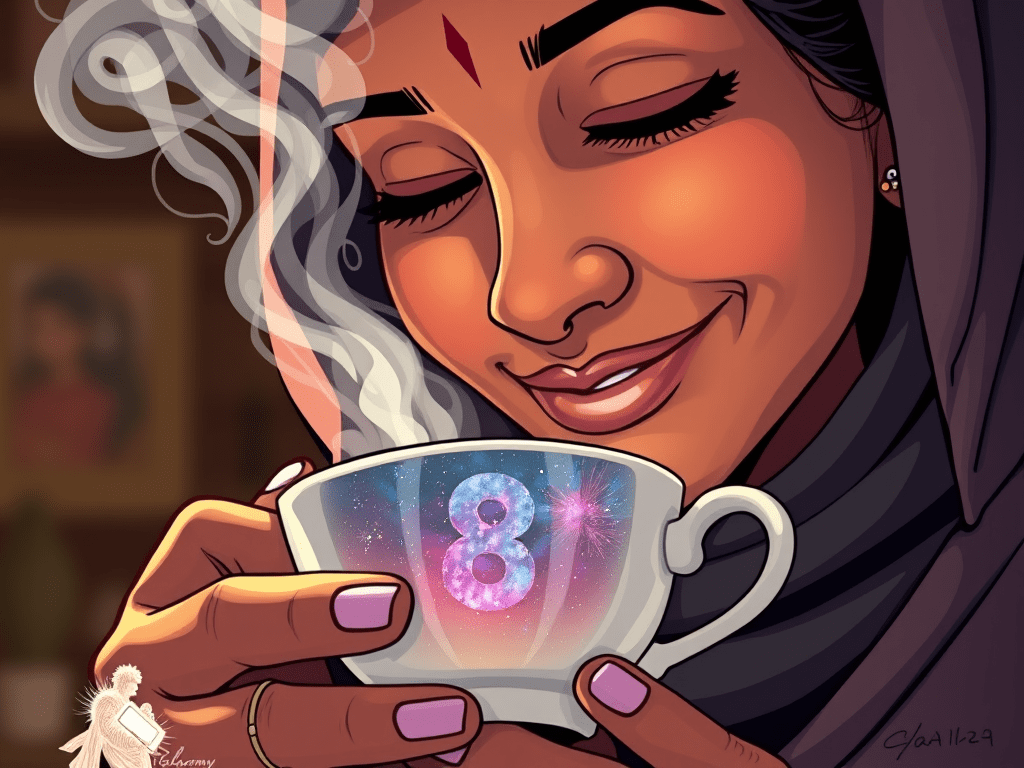
Aryamba had begun to suspect that the universe possessed a wicked sense of humour and the timing of an underpaid stand-up comic.
Just when she had finally started believing herself to be wise, self-aware, emotionally evolved, spiritually tempered by suffering and possibly one breakthrough away from becoming a mountain sage, her daughter looked at her across the dining table and declared:
“Amma, you make literally everything about yourself.”
Not even everything.
Literally everything.
It was the “literally” that hurt.
Another day, in the middle of some entirely unrelated disagreement about misplaced chargers or existential decay or coriander leaves left uncovered in the fridge, came the second verdict:
“And honestly, you have an attitude.”
An attitude.
After six years of panic attacks, nervous breakdowns, spiritual workshops, emergency grounding exercises, aborted suicide attempts, breathwork, shadow work, inner-child work, and enough journaling to qualify as archival material, this was the grand psychological assessment handed down by her offspring.
Not “You are resilient.”
Not “You survived tremendous suffering.”
No.
“You have an attitude.”
Children truly are the final instrument through which God humbles the middle-aged.
Aryamba had spent years healing herself with the seriousness of a woman defusing bombs. Every emotional reaction required analysis. Every difficult interaction became a “pattern.” Every inconvenient person was either “projecting,” “unregulated,” or “operating from wounded attachment.”
At some point, she realized she had stopped having ordinary conversations altogether.
Nobody was simply irritating anymore. They were “triggering unresolved emotional architecture.”
Nobody was selfish. They had “unintegrated trauma responses.”
Even indigestion had become psychosomatic messaging from the body.
The human personality, she had discovered, could survive almost anything except prolonged exposure to therapeutic vocabulary.
Dr. Yuvraj Kapadia often said,
“The more you ask ‘Why me,’ the more the universe throws these at you because you need to find the answer to the why.”
Aryamba now suspected the universe was less a wise guru and more a cat knocking objects off shelves while maintaining eye contact.
Because truly, how many times could one ask why me before the cosmos replied:
Madam, enough. Please proceed to the next chapter.
But she had not proceeded. That was the problem.
Healing had quietly become her full-time occupation, her intellectual hobby, her spiritual identity, and occasionally her personality. She had become a curator of her own suffering. Every wound was polished daily like antique silver.
And the absurd part was this: it all felt productive.
Nothing seduces the human ego quite like introspection. One can spend entire years “working on oneself” while contributing absolutely nothing to civilization except emotionally detailed WhatsApp paragraphs.
Her daughter, irritatingly enough, may have been correct.
Aryamba had become trapped in a closed ecosystem of self-awareness. Every road curved back toward herself. Even compassion had become autobiographical.
Someone else shares pain?
Immediately the mind replied: Yes, this reminds me of my own journey…
Anvi had not accused her of selfishness exactly. That would have been easier to dismiss. What she accused Aryamba of was gravitational self-reference. A condition where every emotional discussion somehow orbited back toward Aryamba’s suffering, Aryamba’s healing, Aryamba’s insight.
It was exhausting.
Even for Aryamba.
And then, as often happened when she became too inflated with philosophy, memory brought Amma crashing into the room like corrective divine intervention.
Amma, who possessed neither therapeutic language nor spiritual branding nor any detectable interest in “processing emotions,” had once said casually at the dining table:
“There is a lacuna here. Since I am handy, I fill it.”
That was it.
No discourse on karmic burdens.
No TED Talk on feminine resilience.
No fourteen-part reflection on boundaries and energetic reciprocity.
Just: There is a gap. I can help. So I help.
The woman moved through life like practical weather.
Amma never collapsed dramatically because she never made herself the protagonist of cosmic theatre. She did not spend six business days asking why suffering had arrived. She simply adjusted her sari, made tea, insulted fate quietly, and continued functioning.
Aryamba found this deeply irritating because it suggested Amma might have understood life better than all the healers combined.
Amma did not over-identify with pain. Nor with goodness. She did not keep emotional accounting books about who sacrificed more. She did not romanticize suffering into identity.
She simply participated.
Detached. Efficient. Occasionally savage.
The older Aryamba became, the more she realized detachment was not coldness. It was refusing to turn every human experience into autobiographical cinema.
Perhaps that was evolution.
Not becoming enlightened.
Not becoming endlessly healed.
Not becoming emotionally fluent enough to weaponize therapy language during arguments.
Just… becoming less obsessed with oneself.
Earth school, she thought bitterly, was apparently not a wellness retreat. It was group work. One was expected to contribute despite being internally ridiculous.
And perhaps that was the real spiritual insult.
Life did not wait for perfect healing.
One had to participate while confused. Love while wounded. Work while fragmented. Help while tired. Show up while carrying entire private civilizations of grief.
No wonder Amma skipped introspection. The woman probably sensed it was addictive.
Aryamba laughed then — a sharp, unwilling laugh that startled even her.
Maybe healing was never meant to become a residence. Maybe it was supposed to be physiotherapy for the soul: useful, necessary, but concerning if still ongoing at Olympic intensity after six years.
The journal lay open before her.
For once, she did not write Why me?
Instead, she wrote:
Enough about me for today. The rice still needs soaking.


Leave a Reply