Lockdowns, Media Memory, Polarization and the Rise of the Hermit Economy
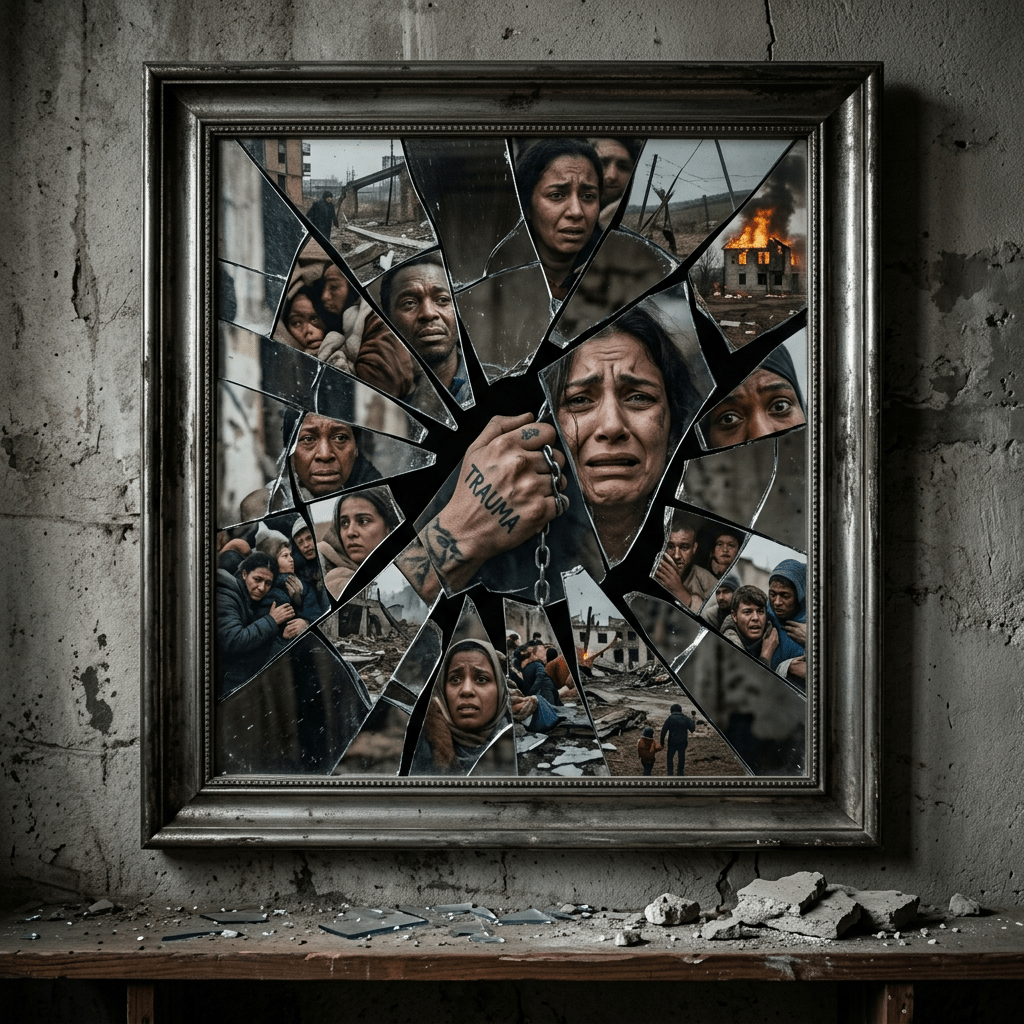
Ah, dear reader, lend me your ear (or at least the corner of your screen). Crises, like bad relatives, do not leave quietly after the tea and sweets are served. They plant themselves in the house and re‑arrange the furniture. When a whole society goes through a wrenching disruption, the leftover fear, grief, and bewilderment don’t evaporate — they sink into the cultural foundations and take up residence. The learned folks call this Cultural PTSD*, which sounds dramatic because, well, it is.
Individual trauma cracks one life. Cultural PTSD* rearranges the neighborhood. It quietly rewrites how people speak to one another, how they trust, how they plan for tomorrow — and then it teaches the children the new rules without ever opening a textbook. If you want a global example, look no further than the COVID-19 lockdowns: a colossal social experiment that altered the choreography of human contact.
How the Tale Moves: From Lockdown to Habit
Imagine a factory that runs on fear and makes habits instead of widgets. The machine’s gears click like this:
[The Trigger: COVID Lockdowns]
│
▼
[The Unresolved Fear] — the invisible threat, the sudden loneliness, the sense of being let down by institutions
│
▼
[*Cultural PTSD* / Safeguards] — hyper-vigilance, emotional numbness, social weariness
│
▼
[Modern Social Behavior] — shorter social stamina, fragile trust, a certain “what’s the point?” air
│
▼
[Passed Down] — children inherit those anxieties through parenting, stories, and the small daily decisions adults make
Three pipes carry this worrying water from one generation to the next:
- Narrative & Language: Words stick. “Social distancing,” “quarantine,” “essential” — these phrases entered the common tongue and didn’t bother to leave. They reshaped how we talk about safety.
- Parenting Dynamics: Kids studied their parents during the crisis and learned the lesson that the world can lock its doors overnight. That lesson is quieter than a lecture but louder than a bedtime story.
- Institutional Structures: Offices, schools, and public spaces remodeled themselves to defend against a threat that, in strict terms, has mostly receded.
A Case Study: What the Lockdowns Did to Us
The COVID lockdowns were a peculiar species of trauma — not a single explosion but a slow, relentless pressure: isolation, uncertainty, and a strange weaponizing of human touch.
- When Rituals Vanished
Weddings, graduations, funerals — the ceremonies that help humans make sense of loss and joy — were sent offstage.
- Psychological toll: We have rituals for a reason; they let grief be public. Deny people the chance to stand together at a funeral and you create disenfranchised grief — sorrow that sits in the room but nobody will admit is there.
- Resulting behavior: A societal dullness. When mourning cannot be communal, sadness hardens into something like collective numbness and cynicism. Life begins to feel clinical rather than lived.
- When Everyone Became a Potential Villain
Suddenly, the neighbor next to you was not merely loud but possibly lethal. A stranger’s cough became an accusation.
- Psychological toll: The basic public bargain — that strangers are mostly harmless — started to fray.
- Resulting behavior: Social fatigue and a rise in agoraphobia-like tendencies. Crowds feel risky, public transport gets tense, and politeness sometimes gives way to suspicion. The “Us vs. Them” story became biological instead of political.
- When Media Makes Memory
There’s another pipe in the transmission system that deserves its own paragraph: the media. During the crisis, messages were broadcast, amplified, and sometimes distorted. When news outlets or social platforms habitually frame events through partisan lenses, what was a public-health emergency can harden into a political memory.
- Psychological toll: Repetitive, adversarial coverage turns traumatic experience into political identity. Facts become badges, fear becomes a political resource, and disagreement becomes moral indictment.
- Resulting behavior: This creates a form of political memory that feeds collective PTSD* — a polarization where stress, mistrust, and grievance are packaged with ideology and passed down as part of cultural lore.
How collective PTSD* Converts to Modern Social Behavior
When these collective fears remain unresolved, they stop looking like a reaction to a past pandemic and start looking like “just the way the world works.” It manifests in several permanent societal behaviors:
- Chronic Scarcity Mindset & Existential Fatalism
The lockdowns proved that the global supply chain, employment, and personal freedom could vanish in a matter of hours.
The Behavioral Shift: Long after the grocery shelves have been restocked, a subtle hoarding mentality remains—whether it is physical goods, digital hoarding, or a compulsive need for financial liquidity. More deeply, it has birthed an existential fatalism (“YOLO” or “live for today because tomorrow might be canceled”). Long-term societal planning, saving, and investing in institutional futures feel pointless to a generation that witnessed the world stop spinning in 2020.
- Hyper-Conformity and the Fracturing of Public Trust
The shifting mandates, conflicting data, and extreme politicization of health during the lockdowns left societies deeply fractured.
The Behavioral Shift: Public trust in media, government, and medical institutions collapsed to historic lows. To cope, society split into echo chambers. On one side, hyper-conformity is used to police group behavior through digital shaming; on the other, an aggressive contrarianism rejects all authority. The shared reality that holds a society together has been deeply compromised.
- The Institutionalization of Isolation (The “hermit economy*”)
The adaptive survival mechanism of the lockdown was to retreat indoors and digitize everything.
The Behavioral Shift: What began as a temporary safety measure has hardened into a permanent cultural shift. The rise of the “hermit economy*”—where remote work, contactless delivery, and digital socializing are preferred over physical gatherings—is a direct manifestation of Cultural PTSD*. Society has codified isolation into a convenience, masking our collective anxiety about reentry and physical vulnerability as a lifestyle choice.
Breaking the Cycle of Cultural PTSD*
Because these social behaviors are driven by unresolved fears, they outlive their usefulness. A behavior that kept us alive during a lockdown—staying inside, viewing others with suspicion, numbing our grief—becomes a psychological prison in peacetime, limiting human connection, creativity, and collective growth.
Healing Cultural PTSD* requires a society to intentionally look backward. It requires us to acknowledge that our current irritability, social exhaustion, and deep-seated cynicism are not permanent flaws in human nature, but the lingering emotional echoes of a world that was collectively traumatized—and is still trying to learn how to feel safe again.
We heal by naming the hurt, by recreating rituals that let grief breathe, by rebuilding trust in small steps, and by choosing connection even when it feels awkward. In short: we must practice being human again, deliberately, like learning an old dance whose steps we forgot during a long winter.


Leave a Reply