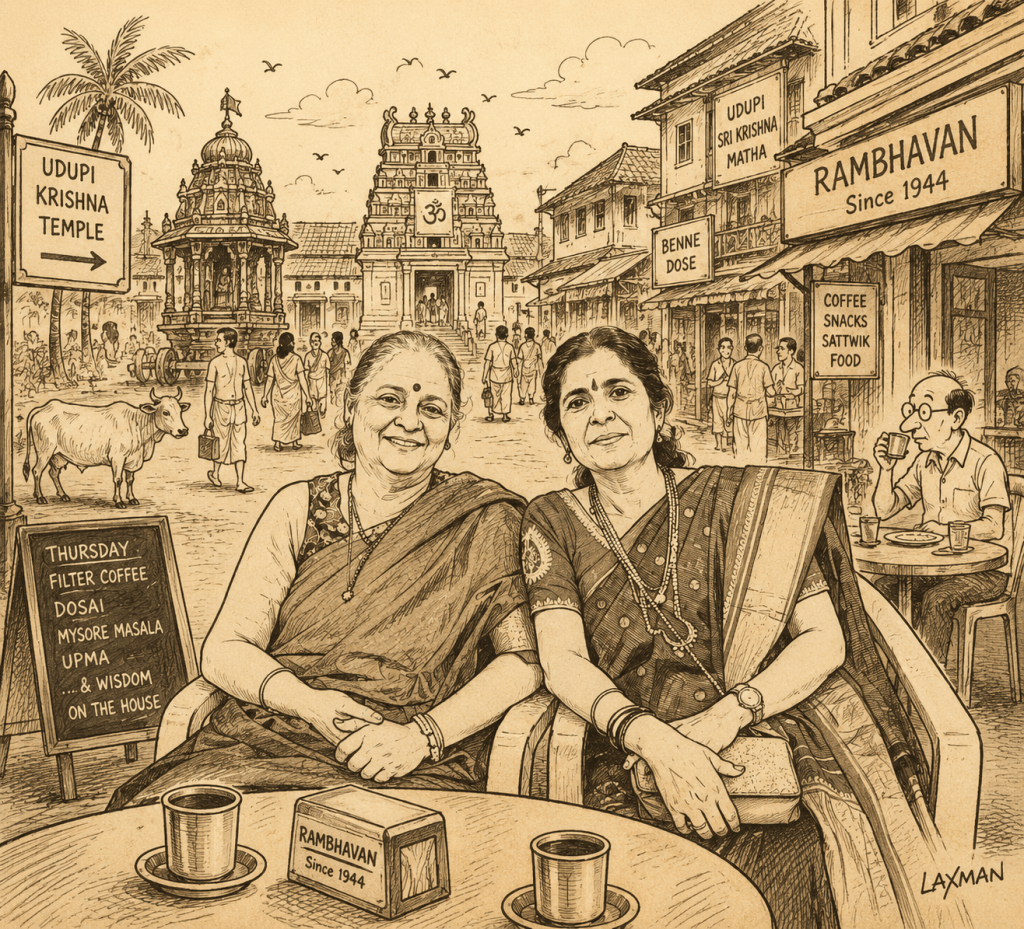
Aryamba’s Thursdays at Rayara Mattah and Ram Bhavan.
Of Enlightenment, Prasadam and Other Retail Experiences.
“Find a guru,” proposed the Akashic reader, looking terribly solemn.
“Find a guru,” agreed Ganapathi Anna. Anna was the local oracle and intuitive healer, a man who dispensed cosmic wisdom with the same casual authority that others dispensed directions to the bus stand. He even specifically recommended Raghavendra Swami.
The suggestion immediately triggered an involuntary flashback.
Aryamba’s mind flew straight back to the chaotic zoo of the Rayara Mattah tucked into a corner of Udupi’s Rathabeedi. To the children, the Mattah was never a place of quiet devotion. It was a magnificent madhouse—a swirl of voices, colours, gossip and humanity.
The parental rule was simple. Finish your prayers, collect your theertha and park yourself near Jalajamma.
Jalajamma commanded the local bhajane group with the authority of a small-state dictator. Years later, this gathering would evolve into the grandly named Raghavendraswami Bhajana Mandali. Back then it was simply Jalajamma’s circle of singers.
Aryamba’s older cousins—Malathi, Nalini, Vrnda and Vishalu—sat nearby doing a thoroughly unconvincing job of learning hymns because they were far more interested in studying the crowd. Ramesha and Umesha mumbled stotras while stealing strategic glances at the girl gang.
Meanwhile, the priest distributed theertha and community intelligence in equal measure.
“How is your son’s engineering?”
“When is your daughter’s wedding?”
“Did Govinda get the bank job?”
No question was considered private within temple premises.
Varijamma whispered matrimonial possibilities to Govindaraya, the community’s original shaadi.com. Jankamma was giving Jayalakshmiyamma a detailed account of her latest mother-in-law troubles. Somewhere, somebody was discussing gold prices. Somewhere else, somebody was discussing blood pressure.
God, one suspected, listened patiently to all of it.
Even today, if All India Radio Mangaluru or some FM station played Dr. Rajkumar’s Vaara Bantamma, Aryamba did not see saints or deities. She saw Jalajamma.
And froze.
Now Nimmi was saying the same thing.
“Find a guru.”
Nimmi—or Nirmala Shenoi, to use her respectable name—had recently acquired a working knowledge of numerology and was applying it with missionary zeal.
“Aryamba, with your numbers, you should have been a guru yourself,” she declared.
Aryamba raised an eyebrow.
“Instead you are writing diaper stories.”
A pause.
“Haa! Because you don’t have a guru.”
For one alarming second Aryamba imagined a hybrid apparition—half Raghavendra Swami, half Sadhguru—floating over a temple tank in designer saffron robes, headset microphone attached, dispensing enlightenment packages.
An even nastier voice inside her head immediately supplied a title.
Maa Dosa Kurma.
Aryamba nearly choked on her coffee.
Everyone seemed to have a guru these days.
ISHA. Art of Living. ISKCON. There appeared to be a spiritual franchise available for every temperament and budget. Followers spoke of vision, mission and transformation with the earnestness of management consultants unveiling a quarterly report.
Only recently a group of enthusiastic ISKCON youngsters had converted an entire railway compartment into a travelling kirtan hall.
Aryamba’s relationship with ISKCON remained uncomplicated.
The theology was negotiable.
The prasadam was not.
Her own spiritual scorecard was hardly empty.
There had been Sathya Sai Baba and Balavikas in childhood, mostly because she loved the stories.
Then came Maharishi Mahesh Yogi. Her grandmother had initiated her into Transcendental Meditation at a time when Mahesh Yogi was considered the very definition of spiritual cool.
Later she discovered Sri Aurobindo.
More recently it was the Dalai Lama, largely because he could discuss neuroscience and compassion without sounding either mystical or ridiculous.
While Nimmi continued analysing moon influences and destiny numbers, another memory surfaced.
Years ago, seated in the Krishna Mattah, Aryamba had heard the Admar Seer remark:
“There are sixty-four gurus in every seeker’s life. The guru appears when the student is ready.”
A more recent version came from Dr. Yuvraj Kapadia:
The guru appears when the student/seeker/adept/inquirer
is ready and leaves when the wisdom is gained.
Dr.Yuvraj Kapadia.
That sounded less mystical and more practical. Very much ask and thou shall recieve.
It shifted the focus from the guru to the seeker.
As Adi Shankaracharya says in the Vivekachudamani:
अधिकारिणमाशास्ते फलसिद्धिर्विशेषतः ।
उपायाः देशकालाद्याः सन्त्यस्मिन् सहकारिणः ॥
Adhikāriṇam āśāste phalasiddhir viśeṣataḥ; upāyā deśakālādyāḥ santyasmin sahakāriṇaḥ.
Success depends primarily upon the fitness of the seeker. Time, place and circumstance merely assist.
The point was uncomfortable in its simplicity. No guru, however exalted, could do the work on behalf of the student.
And again:
अतो विचारः कर्तव्यो जिज्ञासोरात्मवस्तुनः ।
समासाद्य दयासिन्धुं गुरुं ब्रह्मविदुत्तमम् ॥
Ato vicāraḥ kartavyo jijñāsor ātmavastunaḥ; samāsādya dayāsindhuṃ guruṃ brahmaviduttamam.
The seeker must enquire into the nature of the Self under the guidance of one who knows, and whose wisdom is tempered by compassion.
Aryamba contemplated this over a tumbler of filter coffee.
Perhaps the real question was not, “Where is my guru?”
Perhaps it was, “What lesson am I finally ready to learn?”
Which Guru walked beside me
one of clarity or one of craving?
Am I seeking wisdom or merely reassurance.
Is the next learning about order or shadow.
can I hold both together — not as opposites but as a sacred tension.
The coffee had grown cold.
The enquiry had not.


Leave a Reply