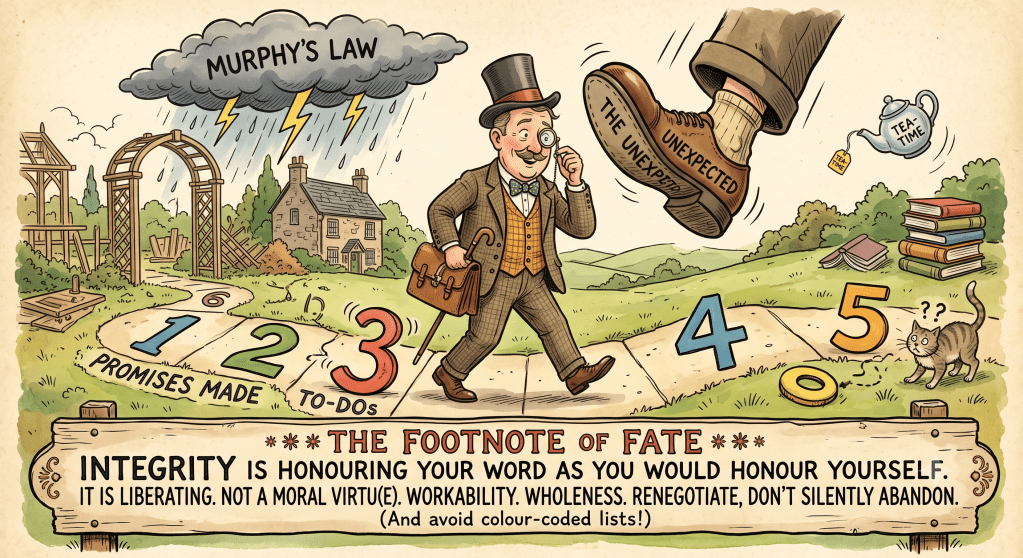
On the Matter of Integers, Bank Queues, and Dr. Victoria Cahn
I was in the middle of a rather delicate morning ritual—colour-coding my To-Do list with the quiet intensity of a man planning a bloodless coup—when Dr. Victoria Cahn dropped by.
Now, Victoria is not the sort of person to whom one casually offers a lukewarm biscuit. She possesses that formidable, razor-sharp pragmatic air that leaves one feeling instantly as though one’s posture, life choices, and daily schedule are all fundamentally flawed.
“What on earth are you doing with those highlighters?” she inquired, inspecting my desk with the mild alarm one usually reserves for finding a ferret in the teapot.
“Categorizing my existence, Victoria,” I replied, waving a pastel yellow marker with a flourish. “Urgent, important, not urgent, terribly important. I’ve even added a section for civic duty. Today, I save the planet using recycled paper.”
She peered closer at the recycled scrap resting beneath my tea mug. “And the footnote?”
“Ah. A bit of unsolicited moral philosophy from the print shop. It says: Integrity is honouring your word as you would honour yourself. Rather uplifting, don’t you think?”
Victoria let out a soft, dry snort that nearly rattled the chinaware. “It sounds like a corporate retreat banner designed by a man who has never tried to navigate a Monday morning. It’s thoroughly drenched in preachiness.”
“I was rather feeling that way myself,” I admitted, sinking into my chair. “I pledged to tackle my mother’s banking business today and attend her afternoon gathering. Instead, I spent four hours trapped in a bureaucratic purgatory of bank counters, derailed entirely by hunger pangs and a series of urgent bladder crises. I am no hero. I am not even a competent hero’s sidekick. By four o’clock, I had accomplished half of one task, the To-Do list was in tatters, and the footnote was hovering over me like an impending doom.”
Victoria settled into the armchair opposite, adjusting her cuffs with devastating composure. “My dear, your primary error is treating integrity as a moral halo. You’ve put it in the same unbearable sorority as righteousness and keeping your nose clean. It’s why you’re sitting there wallowing in self-flagellation.”
“Is it not a virtue, then?”
“Good lord, no,” she said crisping up instantly. “Virtue is exhausting. Integrity is simply a matter of workability. It’s mechanics, not Sunday school.”
I blinked. “Mechanics?”
“Consider the word itself,” Victoria said, leaning forward. “Integer. A whole number. Unfragmented. In clinical work, we don’t ‘fix’ people by slapping a moral gold star on their foreheads; we integrate the fragmented bits—the terrified child, the furious adolescent, the adult who went numb just to survive the week. Integrity isn’t about being ‘good.’ It’s about whether the system functions without falling to bits.”
She gestured toward my chaotic desk.
“When you casually abandon a promise to yourself—’I’ll write for thirty minutes,’ ‘I’ll actually rest this weekend’—no audience gasps. No constable arrives to clap you in irons. But a tiny, hairline crack forms in your internal machinery. Your nervous system simply registers: Ah, their word is negotiable. Best not rely on them. You end up quietly fracturing your own self-trust. It’s an absolute nuisance to repair later.”
“So what is a chap to do when the bank queue takes four hours?” I asked. “Am I doomed to total structural failure?”
“Nonsense,” Victoria snapped, though not unkindly. “Life shifts. Murphy’s Law is the only reliable law in the cosmos. Integrity doesn’t demand that you blindly charge into brick walls to keep a promise. It merely demands that you don’t silently abandon it.”
“Meaning?”
“Meaning you renegotiate,” she said, tapping the table for emphasis. “A frank, timely ‘no’ is infinitely more civilized than a polite ‘yes’ followed by a quiet disappearance. If the bank consumes your afternoon, you pick up the telephone, state the cold facts, and restore the arrangement. You repair the gap before it becomes a abyss. It’s precisely how Zeenat Aman managed her affairs at Savvy magazine back in the day—she wasn’t just brilliant, she was utterly, delightfully reliable. She showed up when she said she would. That’s what keeps the machine running.”
She stood up, smoothing her jacket, having delivered enough wisdom to power a small municipality.
“The banking task will still be there tomorrow,” she added, heading toward the door. “Not because you are a sinner who must repent, but because you are a whole human being simply resetting the terms of engagement. Now, put away those ridiculous highlighters and make a fresh pot of tea.”


Leave a comment