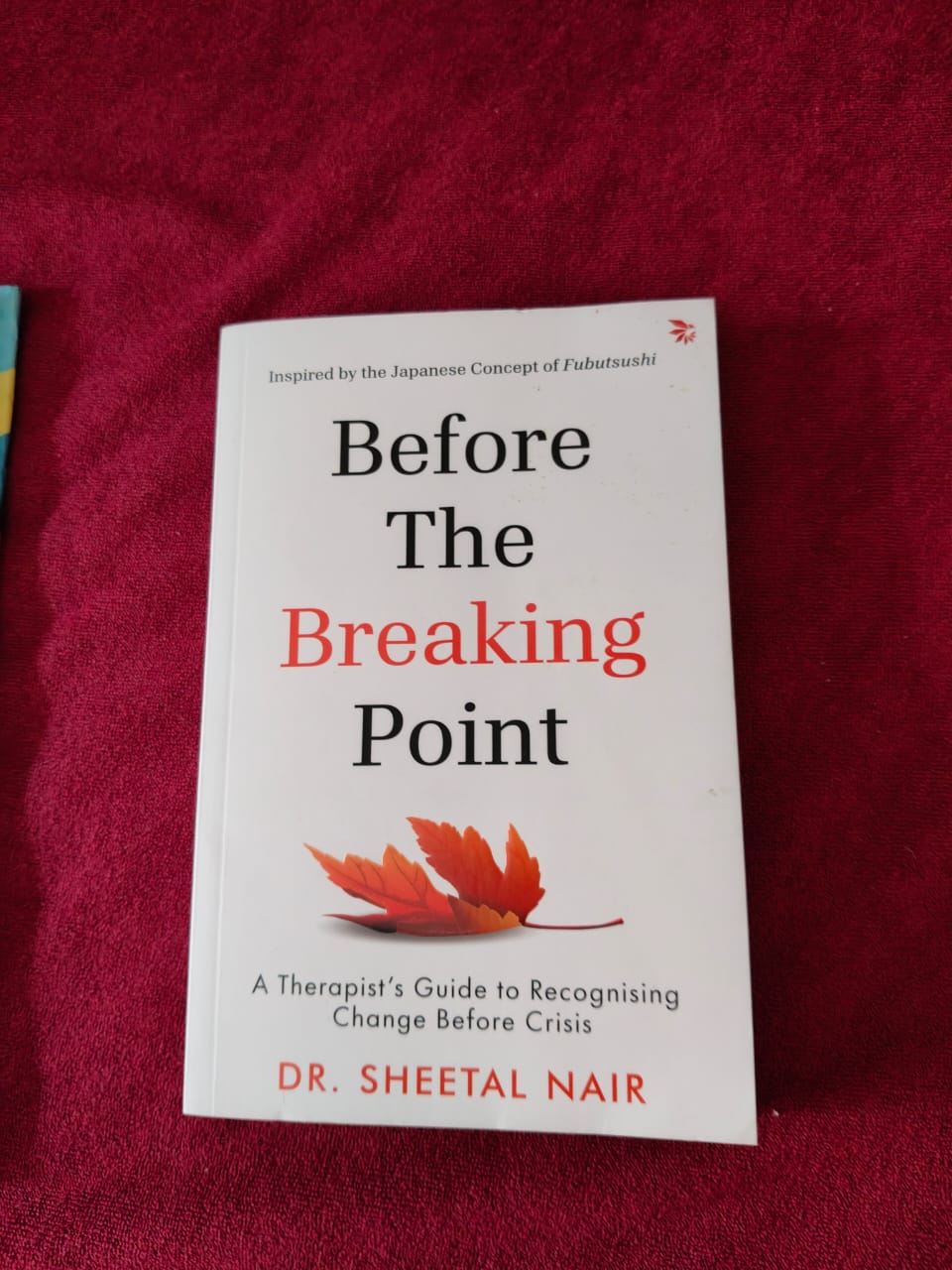
Book Review
Author: Dr. Sheetal Nair
- Publisher: Nu Voice Press
- Distributor: Penguin Random House India
- ISBN: 9788168543232
- Cover Design: HubHawks
- Rating: ★★★★☆
1. Context: The Inspiration Behind the Book
The book draws its inspiration from the Japanese concept of Fubutsushi—a poetic awareness of seasonal transitions and the subtle signs that announce change before it becomes undeniable. It is the scent of petrichor before the downpour, the sudden crispness in the air before autumn arrives, or that quiet, indefinable instinct that something has shifted before language can name it.
Before the Breaking Point is not simply a study of collapse. At its heart, it is about recognizing which season of life you currently inhabit and interpreting the signals that define it. Dr. Nair’s premise is straightforward: every season carries distinct markers, rhythms, warnings, and opportunities. The challenge lies in attuning ourselves to them before external circumstances force our hand.
This theme immediately evokes Kalidasa’s Ritusamhara, where seasonal shifts serve as mirrors for human emotion, behavior, and psychological states. Much like Kalidasa used the natural world to map the human condition, Dr. Nair uses seasonal transitions as an architecture for understanding personal disruption, recovery, growth, and renewal. Through personal anecdotes, client case studies, global events, and keen observations of organizational leadership, the author explores how tuning into subtle cues clarifies where we stand—and what lies ahead.
2. Concept: The Core Framework
The book operates on an accessible, intuitive progression:
$$\text{Recognize the season} \longrightarrow \text{Understand the signals} \longrightarrow \text{Create the required shift}$$
Throughout the chapters, Dr. Nair invites readers to pause and consider four diagnostic questions:
- What season am I in?
- What signs are present?
- What is this season asking of me?
- What shift is required before I reach a breaking point?
This framework is reinforced through concentric-circle models linking awareness, understanding, and decisive action.
A few specific concepts stand out:
- The First Hour of the Day: Dr. Nair frames this as the critical juncture where we receive twenty-four unwritten hours and set the neurological tone for how the mind meets reality.
- The Alarm Clock as Disruption: His observation that mechanical alarms are an unnatural intrusion into bodily homeostasis reframes our default morning friction.
- The Smile as a Neurological Directive: While viewing a smile purely as a biological command might sound clinical—particularly from a performing arts perspective—it is grounded in physiology. Beyond simple facial musculature, smiling acts as biofeedback, signaling safety to the nervous system so the day can begin without defensive resistance.
3. Content: Architectural Structure
The book is meticulously structured—so uniform in its rhythm that one might half-joke it resembles an algorithmic template.
Most chapters adhere strictly to a clear cadence:
- Opening quote (frequently drawing on Thich Nhat Hanh to establish a contemplative tone)
- Narrative hook
- Personal reflection
- Client case study
- Practical hack
- Mechanistic explanation of why the hack works
- The Fubutsushi parallel
- Guided practice exercise
- Anticipated outcomes (shifts and insights)
- An international perspective
- Author’s synthesis and conclusion
This structural consistency makes the book straightforward to navigate, allowing the core themes to compound systematically from chapter to chapter.
4. Craft: Themes, Crosscurrents, and Clinical Realities
The book’s primary strength lies in how fluidly it bridges psychology, mindfulness, neuroscience, and lived clinical insight.
In Chapter Four, where Dr. Nair examines reclaiming the dawn, echoes of the Usha Suktam—the Vedic hymns celebrating the arrival of morning light and fresh potential—emerge naturally. His reflections on the modern scarcity of unscheduled time strike an equally vital chord. It recalls a dialogue I observed years ago between two educators at Manipal Primary School (Madhav Kripa), noting how the pressures on middle-class parenting were turning structured life into an endurance test, leaving school as one of the few places children could simply exist. This same necessity for open, unstructured hours sits at the core of Julia Cameron’s work with “Morning Pages” and “Artist Dates.”
Other observations offer sharp psychological clarity:
- The Anatomy of Interruption: Dr. Nair notes that we often interrupt because we cannot tolerate the discomfort of uncertainty in conversation.
- The Safety of Being Heard: The insight that the nervous system equates genuine listening with somatic safety is both profound and practical.
- Embodied Trauma: His emphasis on bodily signals closely mirrors the developmental phases of The Artist’s Way. As someone navigating personal trauma recovery alongside thirty-five years of clinical practice, one particular passage rang entirely true:
Too much movement after trauma or an accident can be overwhelming. Too little movement traps the memory.
In clinical practice, a severe injury, somatic breakdown, or accident often marks the final phase of an ignored internal dialogue. When the early, subtle seasonal cues are disregarded, the body eventually forces a reckoning in concrete terms.
5. Critique: Strengths and Stretches
While the seasonal motif provides an elegant foundation, it does not land with uniform weight across all twelve months. It feels most potent in the exploration of Autumn—where themes of surrender, emotional harvest, and deliberate release align organically with the psychological shifts being discussed.
Dr. Nair’s treatment of familiar virtues is refreshingly pragmatic:
- Gratitude as Nervous System Regulation: Rather than treating gratitude as a moral imperative, he reframes it as somatic feedback that signals baseline safety to the brain. While his anecdote of a family adopting dinner table reflections sounds modern, it is fundamentally the contemporary reinvention of saying grace.
- Forgiveness as Energy Reclamation: He positions forgiveness not as an absolution of the past, but as a deliberate refusal to let historical events monopolize future bandwidth—a physiological boundary rather than a spiritual obligation.
If there is a stylistic reservation, it is the recurrent reliance on high-profile international client profiles, which can momentarily read like unnecessary credential-polishing. Fortunately, these accounts serve a broader purpose, reinforcing that these psychological patterns transcend cultural and geographic lines.
6. Contribution: Why the Book Resonates
Before the Breaking Point succeeds as a manual for recognizing personal seasons before they escalate into crises. Whether unpacking morning routines, physical trauma, active listening, or emotional regulation, Dr. Nair consistently brings the reader back to the fundamental inquiry:
What season are you inhabiting, and what signals are trying to get your attention?
By encouraging hyper-awareness of quiet, internal indicators, the text offers a grounded toolkit for meeting life’s transitions with less friction. Much like Ritusamhara, it reminds us that seasonal shifts are not merely external phenomena—they are internal terrains we must learn to read and inhabit.
Who Should Read This Book?
- Readers interested in applied mindfulness and emotional self-regulation
- Therapists, executive coaches, and somatic practitioners
- Anyone navigating career transitions, chronic stress, or burnout recovery
- Readers of Julia Cameron (The Artist’s Way) and Thich Nhat Hanh (Peace Is Every Step)
- Those who prefer structured, practice-oriented personal development over abstract theory
Verdict: Highly recommended. A disciplined, accessible roadmap for reading personal transitions before circumstances force a crisis.
Recommended Companion Reads
- The Artist’s Way by Julia Cameron — for cultivating creative resilience and unblocking expression through reflective routine.
- Peace Is Every Step by Thich Nhat Hanh — for grounding presence, somatic calm, and mindful engagement with daily life.
Reference & Links
- More Reviews:Kitabi Kida / My Bookshelf
- Author:Dr. Sheetal Nair (Author | Storyteller | Serial Entrepreneur)
- Publisher: Nu Voice Press
- Distribution: Penguin Random House India


Leave a Reply