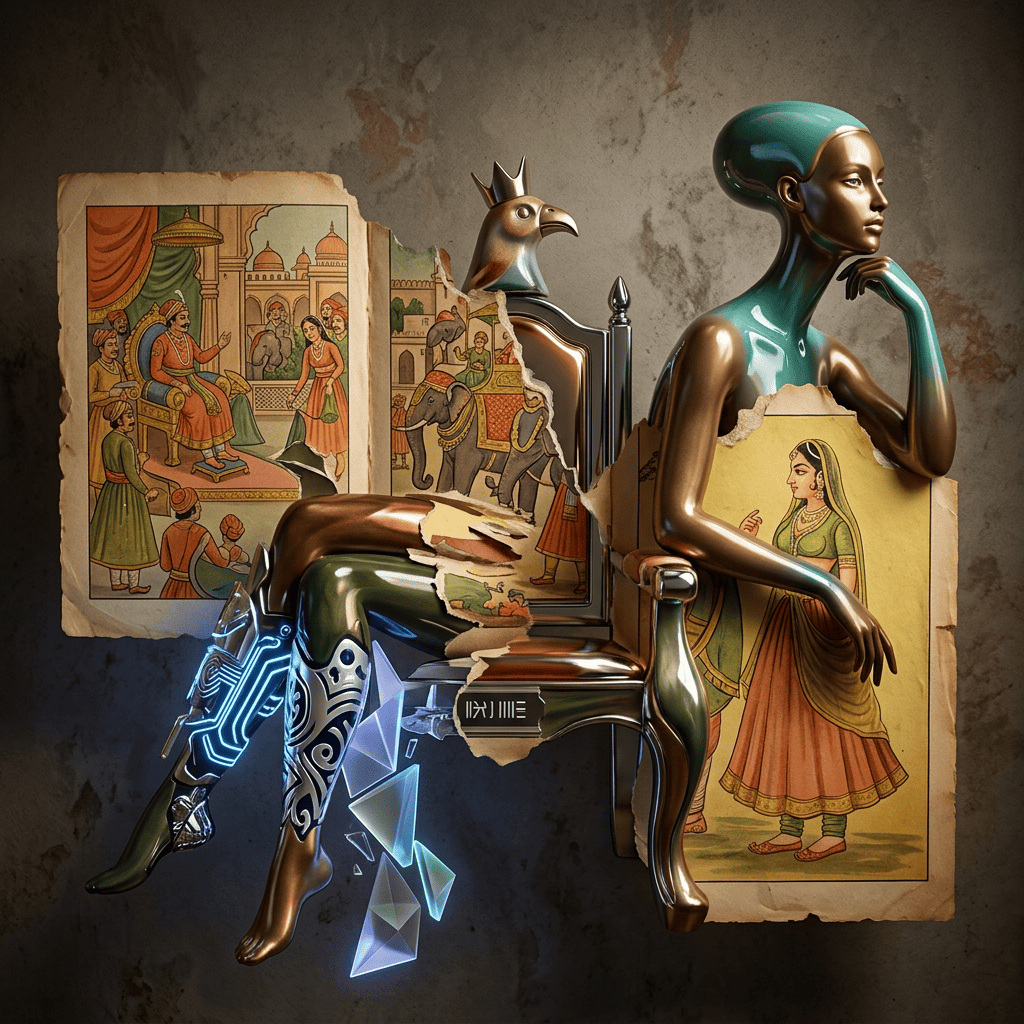
From Amar Chitra Katha to Amar Chitra Kachra
Once upon a time, when we were young and impressionable, Amar Chitra Katha was our staple diet. We had apsaras bejewelled to within an inch of their lives, rishis lean and luminous despite centuries of tapasya, kings radiating royal authority, and villains equipped with moustaches that could have sheltered a family of sparrows.
There was a certain visual grammar to the whole enterprise. Goodness was handsome, evil was hairy, and divinity came with excellent jewellery. Even Bollywood, in its mythological and historical moods, more or less followed the template. Nobody was going to mistake the villain for the hero unless the plot was exceptionally complicated or the audience had arrived late.
Then came the age of AI, and apparently the Indian film industry outsourced its imagination to one overworked fellow who owns a gym, a beard trimmer and a single mood board labelled MEDIEVAL MEN: ANGRY, DUSTY, EXPENSIVE.
Every male character, protagonist or antagonist, now appears to have been assembled from the same starter kit. Take a little Ranveer Singh from Dhurandhar, add the menace of Khilji from Padmaavat, stir in Saif Ali Khan from Chhaava, sprinkle liberally with Akshaye Khanna from the film whose name has inconveniently escaped me, and there you have it. One more brooding man with intense eyes, an overdeveloped sense of grievance and enough facial hair to qualify for agricultural subsidies.
The distinctions between hero, villain, emperor and miscellaneous gentleman with a sword have become largely academic. They all look as though they have just returned from an unsuccessful siege, spent a week in a stable or lost a bet involving mud and a lifetime ban on soap.
And then there is the body.
The six-pack. The gym-sculpted torso threatening to burst out of its costume. Abdominal muscles so individually defined that one could teach first-year anatomy from them; pectorals threatening independent political status; biceps apparently requiring their own security detail. The whole arrangement looks less like the consequence of wielding swords and riding horses than a desperate attempt to win a bodybuilding competition.
When, precisely, did our kings and warriors enrol in a twenty-first-century fitness programme? Who was minding the kingdom while His Muscular Majesty completed his fifth set of incline dumbbell presses? Who collected the taxes while the emperor checked his vascularity under studio lighting?
One suspects the casting brief now specifies that the actor must be capable of lifting a horse, throwing a palace guard through a wall and bench-pressing the royal treasury. Whether he can actually sit on a horse for six hours, wear armour in the Indian summer or survive a day without a protein shake is a question best left to historians and physiotherapists.
And just when one thinks the spectacle cannot become more absurd, along comes the unkempt man bun: that greasy little knot of hair perched on the back of the head, with stray tendrils escaping around the ears and a beard apparently cultivated during a famine. It is the coiffure of a man who has spent three hours in a styling chair being made to look as though he has never encountered one.
This, apparently, is historical ruggedness. Not the weathered dignity of someone who has lived, fought, travelled and ruled, but the carefully manufactured dishevelment of a man who has lost a fight with a coconut tree.
The irony is delicious. It takes an army of stylists, personal trainers, lighting technicians and digital artists to produce a man who looks as though he cannot afford a bar of soap.
I would dearly love to see one of these gentlemen sit down to a historically plausible meal without a nutritionist calculating his macros. Imagine a Mughal emperor refusing the royal feast because the biryani does not fit his cutting phase, or a Rajput warrior pausing before battle to ask whether his armour makes his deltoids look small. Imagine a rishi interrupting his meditation to adjust his man bun in the reflection of a brass lota.
And now we have the latest Shah Rukh Khan poster for his forthcoming film. One look and one wonders whether somebody has taken Ranveer Singh’s Dhurandhar poster, applied an ageing filter and sent it back into circulation. The face changes; the beard, brooding expression and general atmosphere of civilisational collapse remain.
I have seen things no human should see, and I shall now stare at you until you buy a ticket.
Apparently, the new benchmark for masculine charisma is to look permanently traumatised, vaguely feral and insufficiently acquainted with running water. A man who appears clean, rested and capable of finding his own bathroom presumably cannot be trusted to conquer a kingdom.
I dread the day one of the young ‘uns gets inspired to make a film on Genghis Khan. Imagine the great Mongol emperor turning up looking like Alauddin Khilji, complete with the regulation man bun, steroid-pumped torso and the expression of a man who has just discovered that the Silk Road has run out of protein powder. At this rate, the Mongol hordes will gallop across the steppes looking like an army of disgruntled Bollywood gym trainers. History may never recover.
The women, meanwhile, are expected to do the heavy lifting with jewellery.
Which brings me to another longstanding irritation. When it comes to queens and goddesses, South India seems to disappear into a convenient cinematic black hole. Our visual history is vast and regionally diverse, but the moment an Indian queen needs to be dressed, the costume department seems to reach for a generic royal wardrobe, add gold, and declare the matter settled.
Take the sari. There is no single, timeless Indian way of draping one. Maharashtra’s distinctive nauvari, traditionally worn in a dhoti-like style, is not interchangeable with the drapes associated with Tamil Nadu, Kerala, Karnataka or Andhra-Telangana. The veshti and upper-cloth combinations of Tamil traditions, Kerala’s mundu-neriyathu, the varied sari traditions of Karnataka, and the distinctive textiles and draping practices of the Telugu-speaking regions each carry their own histories. Nor did these traditions remain frozen across centuries; region, community, period and occasion all mattered.
Yet our queens often emerge from a pan-Indian costume laboratory where geography is a rumour and history an optional extra. A little Kanjeevaram here, some temple jewellery there, a crown of indeterminate provenance, and voilà: one more South Indian queen, apparently dressed by someone whose entire knowledge of the South comes from a wedding invitation.
Temple jewellery is not a substitute for historical research. Nor is a silk sari, however magnificent, proof that the drape, blouse, ornaments and silhouette belong to the period or region being depicted. The details matter. A royal woman in a Chola court, a Vijayanagara palace or a later Kerala household did not necessarily inhabit the same visual world. Treating them as interchangeable is rather like dressing every European queen in a Tudor gown and congratulating oneself on having researched the Renaissance.
We can apparently manufacture ten thousand AI-generated warriors in minutes, but recreating the visual identity of a particular region requires divine intervention.
And this is what makes the whole business especially irritating. AI could, in principle, give us more variety, not less. It could help reconstruct regional textiles, jewellery, architectural details and forgotten visual traditions. Instead, we get interchangeable men with steroid-pumped physiques, the hair of abandoned hermits and the expression of someone who has just discovered that his kingdom’s annual revenue has been spent on protein supplements.
The apsaras have become decorative assets. The rishis appear to have been replaced by men auditioning for a premium beard-oil advertisement. The kings are busy maintaining their body-fat percentage. And the queens are drowning in gold while their regional identities quietly slip out of the frame.
I miss the old Amar Chitra Katha world. At least there, when a king looked magnificent, he looked magnificent. When a villain looked villainous, there was no ambiguity. And when an apsara descended from heaven, one did not wonder whether she had spent the previous evening hiding in a bunker during an air raid.
We went from Amar Chitra Katha to what I can only describe as Amar Chitra Kachra.
Perhaps the next AI-generated historical epic could attempt something truly revolutionary: a king who looks like a king rather than an undertrial; a villain whose evil does not depend on the square footage of his beard; a warrior whose body suggests a lifetime of actual physical labour rather than a contractual obligation to a fitness influencer; a queen dressed in a recognisably researched regional tradition; and a rishi who looks spiritually luminous rather than chronically constipated.
And, for heaven’s sake, a man bun that has met a comb.
Better still, one man who has had a bath.
Just one.
For the sake of Indian civilisation.


Leave a Reply