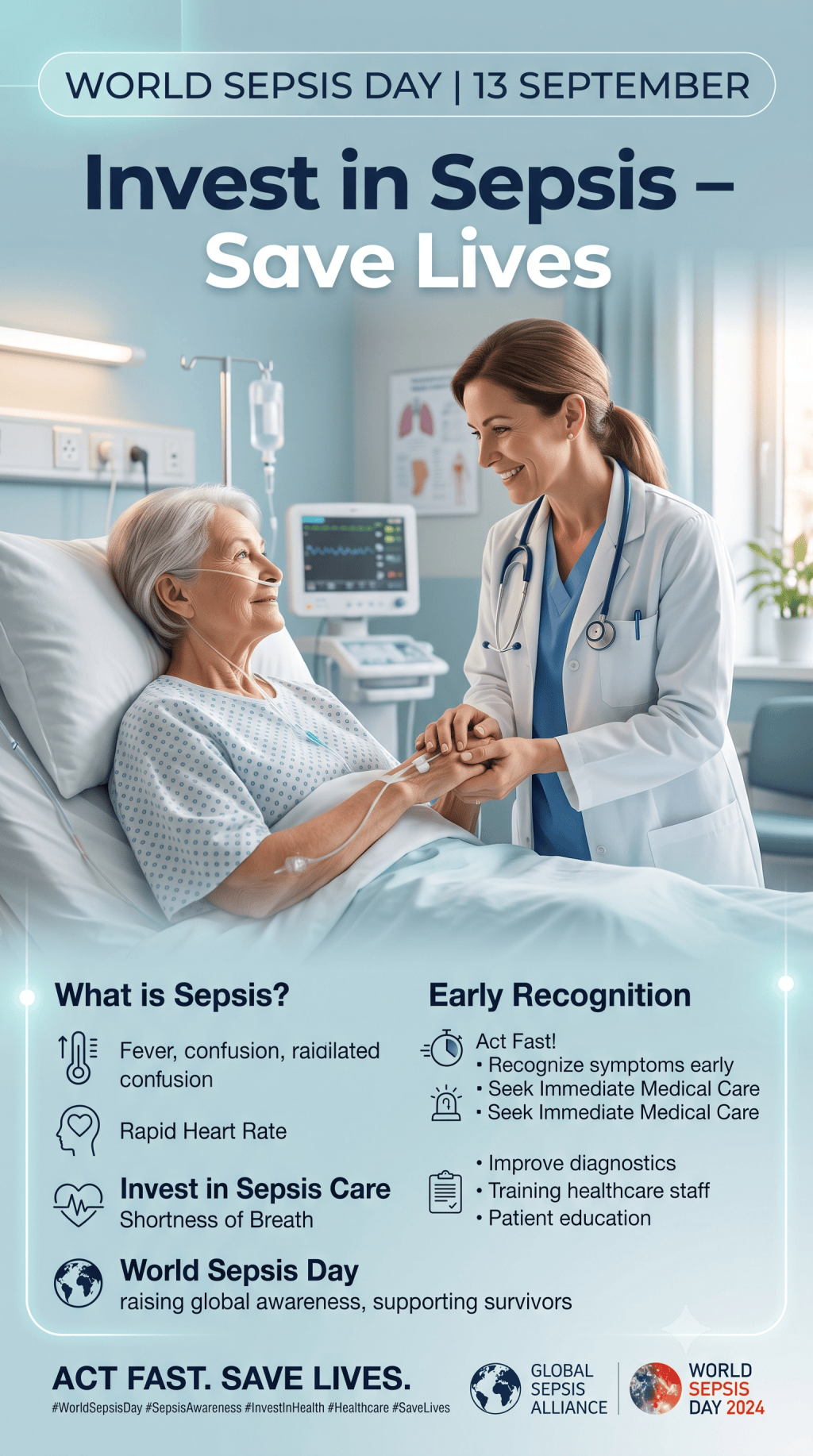

Listening to the Body Before It Screams: Where Pain Awareness Meets Sepsis
“Dodda, did you know the Pharaoh Athensomebody died of septic shock?”
Andy looked up from his heavy, dog-eared book of world history, his round face glowing with that peculiar pride children get when they stumble upon a polysyllabic catastrophe.
Jenny didn’t look up from her drawing pad. She merely paused her green crayon over a drawing of an unsteady camel. “What is septic shock?”
“When the whole body is flooded with sepsis,” Andy pronounced solemnly, before deciding the explanation was complete. Within seconds, both of them had abandoned the mortuary affairs of ancient dynasties and returned to their empire of sand, chariots, and pyramids.
They moved on, but I was left sitting by the window, suddenly miles and decades away.
Andy’s half-remembered Pharaoh had unbolted a heavy door in my mind, sending me tumbling straight back into the humid examination wards of third-year medical college.
It had been the very first bedside clinical presentation of our entire batch. A shy, soft-spoken classmate stood before the bed of an elderly gentleman, his clinical journal trembling slightly in his fingers. The patient was lying there quietly—a little flushed, visibly tired, with a peculiar shallow lift to his chest and a faint, racing pulse. My batchmate had clearing his throat and declared with youthful certainty: “Sir, the patient presents with generalized viral fatigue, mild age-related cognitive slowing, and post-exertional malaise.”
Dr. Vittal Rao had stood at the foot of the iron cot. He was a man who could wither an overgrown ego with a two-second pause. He removed his spectacles, looked at the trembling student, and sighed with that dry, terrifying pity only seasoned clinicians possess.
“Malaise? Fatigue?” Dr. Rao’s voice had dropped to an icy whisper. “Look at the breathing. Look at the bed sheet—he hasn’t passed urine since yesterday noon. Young man, while you are philosophizing about his ‘fatigue,’ his capillaries are leaking like sieves. The man is sliding into septic shock. If you wait for him to scream, you will be writing a death summary instead of a case sheet.”
It had all started with a neglected, cracked shoe bite on the man’s heel.
Sitting with that memory, the sheer truth of Dr. Rao’s words strikes me anew. The body almost never opens a conversation by shouting.
It whispers.
It begins with a vague, bone-deep tiredness that feels slightly out of proportion to the day’s work. A sudden, unexplained shortness of breath when climbing just half a flight of stairs. A racing heartbeat while you are simply sitting at the dining table reading the newspaper.
In the heat of daily life, we don’t treat these as alarms. We treat them as inconveniences—or worse, what we casually brush off as “fancies.”
“Oh, it’s just the humidity.”
“I didn’t sleep properly because of the ceiling fan.”
“Gas problem. Indigestion. I must have eaten too much dal at the wedding.”
In our living rooms and clinic verandas, this dismissiveness is an art form. When an aunt complains of a throbbing ache and breathlessness, someone will invariably say:
“ಒಂದು ಸಣ್ಣ ಗಾಯ, ಅದಕ್ಕೊಂದು ಹರಿಮಾಯಕ ಕಂಡ್ರೆ ಮೈ ಬೆವರೂದೇನು, ಶ್ವಾಸ ಕಟ್ಟುದೇನು… ಕೇಂಬುದು ಬೇಡ!”
(A small little scratch, and look at the fuss—sweating, panting, making such a drama… don’t even ask!)
Or when an elderly grandfather with a smoldering urinary infection starts muddling his sentences, becoming unusually quiet and refusing his tea, the family sits in the hall and sighs:
“Samāchāra sari illa… he is not talking to anyone today.”
Or they wave a hand: “Bidi, mudibranthi… old age, his mind is just wandering.”
We only connect the dots in retrospect. Later—in the intensive care unit corridor, or while staring blankly at a white hospital ceiling—we do the introspection: “He did say his heart was fluttering on Tuesday… She did say her chest felt tight on Wednesday morning…”
In retrospect, the clues are glaring. In the present moment, we convince ourselves it was nothing.
The home remedies–Because we love so deeply, our first instinct when illness knocks is never the clinic; it is the kitchen stove.
We brew pungent pots of shunti-chai (ginger tea) or stir a golden spoonful of turmeric into steaming milk—that eternal, comforting panacea prescribed in Indian homes for everything from broken hearts to bruised knees. And alongside the warm cup, someone invariably hands over a strip of over-the-counter paracetamol to “bring the fever down.”
There is warmth in these rituals. But when an infection is quietly turning systemic, this nurturing instinct carries a silent danger.
Sepsis is not a simple cold. It is a biological crisis where the immune system’s defense mechanism panics and turns upon its own walls. The white blood cells release a torrential flood of chemicals that dilate the blood vessels, causing blood pressure to drop precipitously. Organs, deprived of oxygen, begin to falter.
Turmeric milk and paracetamol will soothe the headache; they might cool a burning forehead for three hours. But they cannot sterilize a bloodstream teeming with bacteria, nor can they halt vascular collapse.
By treating the symptoms, we silence the body’s alarm bell while the fire continues to consume the foundation. Every hour of delay in administering intravenous fluids and targeted antibiotics quadruples the danger.
Why are we so determined to ignore the whisper until it shatters into a scream?
Because in modern life, we have forgotten how to be in dialogue with our own flesh.
Yesterday, around World Sepsis Day
, the focus was on clinical survival. But this September is also Pain Awareness Month, and pain is the missing half of the conversation.
Louise Hay, who spent decades decoding the mind-body dialogue, always reminded us that pain is not a cosmic punishment or an enemy to be drugged into submission. Pain is a messenger asking: “Where are you refusing to listen to yourself? Where are you forcing a tired vessel to keep running on an empty tank?”
Decades earlier, the American mystic Edgar Cayce spoke deeply of the body’s holistic architecture. He observed that chronic mental friction, prolonged exhaustion, and suppressed vitality silently drain the nervous and lymphatic systems, leaving our internal defenses brittle and vulnerable to collapse.
- Pain is the whisper. It is the tap on the shoulder: Rest. Clean this cut. Forgive. Breathe.
- Septicemia is the silence breaking. It is the moment the body, ignored for too long, pulls the master lever. The whisper becomes an overwhelming, systemic scream.
To listen before the scream does not require a stethoscope; it requires humility.
It means paying attention when sudden irritability, brain fog, and withdrawal set in—realizing they are often the early somatic signs of an exhausted immune system fighting off a brewing storm.
It means knowing that when a loved one is suddenly breathing too fast, their heart racing without reason, or their speech growing strangely muddled, it is not “drama,” nor is it just “mudibranthi.”
It is the body, standing on the edge of the cliff, asking you to hear it.
Don’t dismiss it as fancy. Don’t wait to connect the dots in retrospect.
Don’t wait for the scream. Listen to the whisper.
Notes & References
- Clinical Medicine Framework: For clinical bedside evaluation, signs of systemic inflammatory response, and organ dysfunction protocols, see Dr. B. A. Shastry, Manipal Manual of Clinical Medicine (CBS Publishers & Distributors).
- Pharmacology Principles: On the critical pharmacology of timely systemic antimicrobial therapy versus the symptomatic masking effects of antipyretics and analgesics, see R. S. Satoskar, S. D. Bhandarkar, & Nirmala N. Rege, Pharmacology and Pharmacotherapeutics (Elsevier).
- Mind-Body Perspectives:
- Louise Hay, You Can Heal Your Life (Hay House) — exploring pain and physical symptoms as biological, emotional, and spiritual messengers.
- Edgar Cayce (Association for Research and Enlightenment) — on nervous system exhaustion, emotional harmony, and systemic physical resistance.
- Historical Note:The passing mention of the boy-king Tutankhamun’s death following a broken, infected knee and severe malaria remains one of history’s most debated early cases of fatal systemic infection and septic shock.
- Previous Post: Revisit yesterday’s reflections on World Sepsis Day.


Leave a Reply